
Savings Goals by Life Stage: How Financial Priorities Tend to Shift Over Time

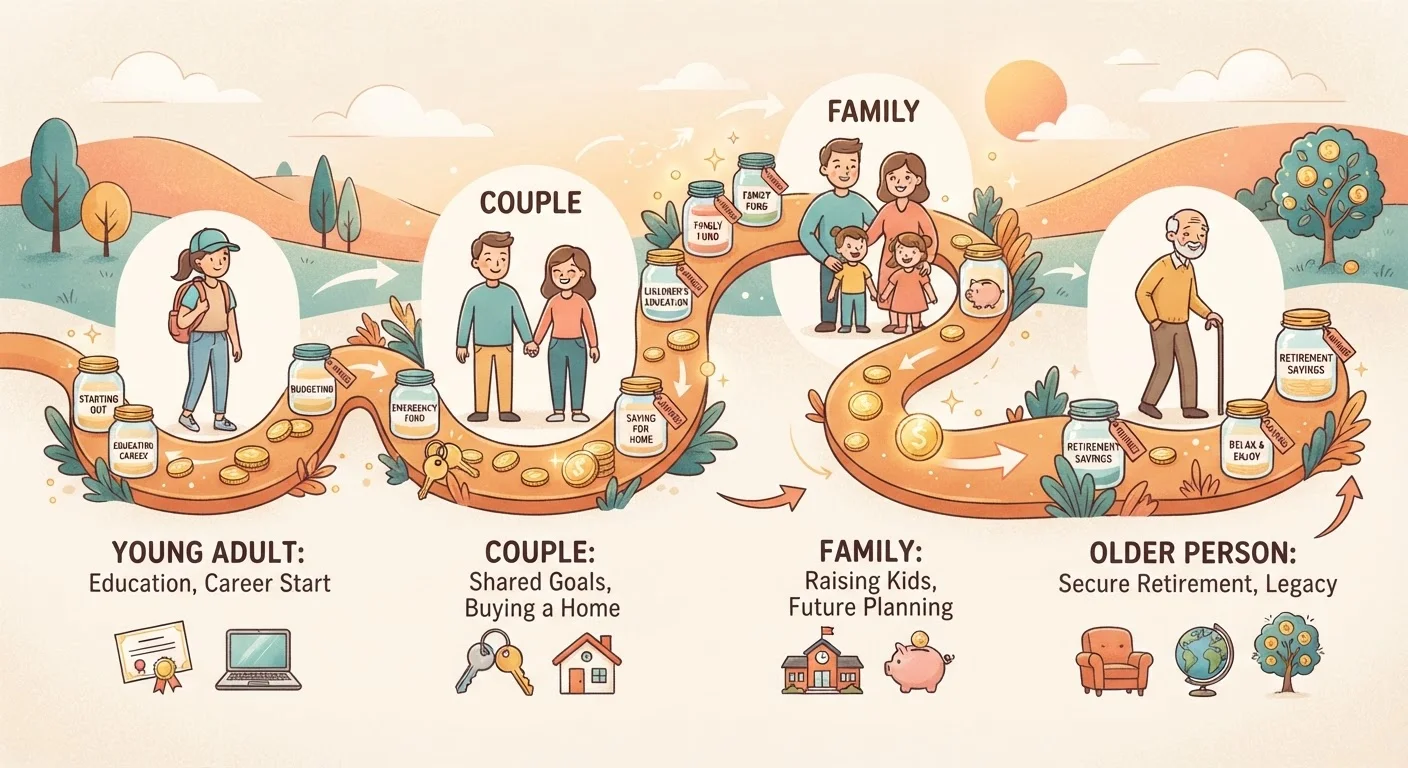
Photo: BridgeWish.com | Reliable Source Of Information editorial
Key Takeaways
- Emergency funds and debt repayment tend to dominate early savings priorities in young adulthood.
- Mid-life savers typically balance competing goals: homeownership, family costs, and retirement contributions.
- The closer you get to retirement, the more important it becomes to shift focus toward income replacement.
- Recognizing your current life stage helps you sequence goals rather than chase all of them at once.
- Flexibility matters - personal timelines vary widely based on income, family structure, and circumstances.
Why Life Stage Shapes Your Savings Priorities
Most personal finance advice treats saving as a single, uniform challenge - spend less, save more. But the what and why behind saving shifts substantially depending on where you are in life. A 24-year-old renting an apartment and paying off student loans is working with a very different set of priorities than a 45-year-old with a mortgage, two kids, and a decade left before retirement.
Understanding how savings goals commonly evolve across life stages gives you a useful frame for sequencing your own priorities rather than feeling overwhelmed by everything at once. The list below maps common financial milestones by stage - not as a rigid prescription, but as a general orientation. Your actual situation may move faster, slower, or in a different order entirely. For foundational budgeting support, the Budgeting Basics hub is a practical starting point.
Sequence Goals, Don't Chase All of Them
Common Savings Priorities Across Life Stages
Early Adulthood (roughly 20s): Build the Foundation
The primary financial tasks in early adulthood typically center on stability rather than growth. That means building a basic emergency fund - commonly cited as three to six months of essential living expenses - and beginning to address high-interest debt, particularly credit cards and private student loans.
Starting retirement contributions early, even at modest levels, matters significantly because of the long time horizon ahead. Many financial educators point to the power of compounding over decades as a central reason to begin as soon as possible, even before other goals feel fully settled.
Starting retirement contributions in your 20s, even small ones, matters more than most people realize.
Late 20s to Mid-30s: Accumulating and Stabilizing
This period often involves layering goals: growing the emergency fund, increasing retirement contributions, and beginning to save toward a home down payment if homeownership is a goal. For many people, this is also when student loan debt repayment intensifies.
The tension between competing priorities is real here. Financial planners often suggest at minimum capturing any employer match in a workplace retirement plan before directing extra dollars elsewhere - that match is considered a guaranteed return on savings, unlike most other options.
Capturing your full employer retirement match before directing savings elsewhere is widely considered a baseline priority.
Mid-Life (roughly 40s): Peak Earning, Peak Competing Demands
The 40s can be financially complex. Many households face simultaneous pressure from mortgage payments, children's education costs, aging-parent care needs, and the growing urgency of retirement preparation.
Retirement savings typically warrants increased attention during these years, particularly for anyone who started late or had gaps in contributions. Some people in this stage also begin thinking about college funding vehicles - though financial advisors generally caution that securing your own retirement should take precedence over funding a child's education, partly because students have access to loans while retirees do not.
Most financial planners advise prioritizing your own retirement funding over college savings during mid-life.
Pre-Retirement (roughly 50s to early 60s): The Final Push
The decade or two before retirement is often described as a critical window for savings acceleration. U.S. tax law allows for higher annual retirement contribution limits for people aged 50 and older - these are often called catch-up contributions and apply to accounts like 401(k)s and IRAs.
Beyond contributions, this stage often involves beginning to think concretely about income replacement: how much monthly income will be needed in retirement, what Social Security may provide, and whether current savings trajectories align with those projections. Getting a realistic picture typically requires more detailed planning than earlier stages.
Catch-up contribution rules allow people 50 and older to put more into retirement accounts each year.
Retirement and Later Life: Shifting from Accumulation to Distribution
Once earned income stops, the financial challenge shifts from saving to managing withdrawals strategically. This includes deciding when to begin drawing Social Security benefits, managing required minimum distributions (RMDs) from certain retirement accounts, and planning for healthcare costs - which tend to increase substantially with age.
Savings in retirement aren't irrelevant - many retirees continue to maintain emergency reserves and may save for specific expenses like travel or home repairs. But the dominant concern becomes making existing assets last, often across an unpredictable time horizon.
In retirement, making existing assets last becomes more important than accumulating new ones.
These stages don't follow a strict calendar. Someone who starts a family later in life, returns to school mid-career, or experiences a significant income disruption may find that priorities overlap or reorder. What matters most is recognizing the dominant goals at your current stage - and making sure your savings behavior is actually aligned with them. For a closer look at typical milestones and realistic timeframes, see savings goals most Americans set.
Life Stage Timelines Vary Widely
Making Progress Without Losing Sight of the Whole Picture
One of the most common mistakes across life stages is treating savings as a single bucket. A short-term goal like a home down payment needs to be kept and managed very differently than a 30-year retirement fund. Understanding this distinction can help you avoid unnecessary risk - or unnecessary caution. The article on matching the account to the goal goes deeper on this.
It's also worth remembering that big purchases can compete with longer-term goals if you're not deliberate about sequencing. The piece on saving for a big purchase without derailing other goals offers approaches for managing that tension. And if you want to build habits that hold up regardless of stage, savings habits that tend to hold up over time is worth a read.
This article is for general informational purposes only and does not constitute personalized financial, investment, or tax advice. Please consult a qualified financial professional before making decisions specific to your situation.
The content on this site is for informational purposes only and is not a substitute for professional advice. Always consult a qualified professional for guidance specific to your situation.