
Savings Strategies Worth Knowing, From Envelope Budgeting to Micro-Saving Apps

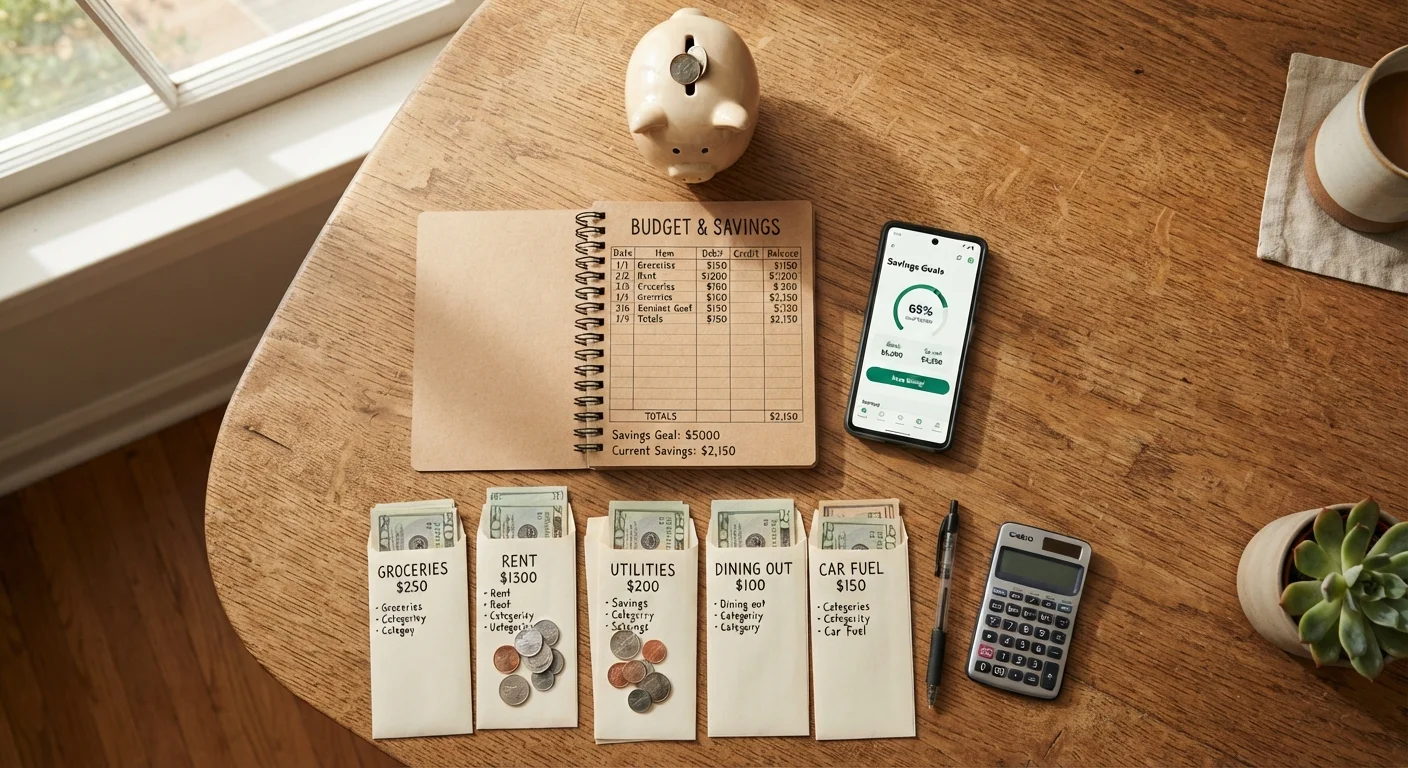
Photo: BridgeWish.com | Reliable Source Of Information editorial
Key Takeaways
- No single savings method works for everyone - matching strategy to your spending habits matters more than picking the 'right' approach.
- Envelope budgeting and micro-saving apps solve the same core problem through opposite mechanics: one adds friction, the other removes it.
- Automating even a small, fixed transfer at payday is consistently cited by financial educators as a high-impact habit.
- Savings rate targets like '20%' are useful benchmarks, but starting with any consistent amount beats waiting until you can save more.
- Understanding where savings plans typically break down can help you anticipate and prevent your own sticking points.
Why Strategy Selection Actually Matters
Most personal finance advice treats savings as a willpower problem. Save more, spend less, repeat. But research and financial planning experience consistently show that method fit - matching a savings approach to how you actually think about money - has more influence on outcomes than motivation alone.
That's worth holding onto as you read through the strategies below. None of them are universally superior. Each one works well for a specific type of spender, income pattern, or psychological relationship with money. The goal here is honest context, not a ranked list.
For a grounding overview of how savings fits into the broader US financial picture, see our complete savings overview. And if you want to understand why many well-intentioned plans quietly fail, this look at common savings pitfalls is a useful companion read.
Envelope Budgeting
Envelope budgeting is one of the oldest cash-management systems still in active use. The mechanics are simple: withdraw your take-home pay in cash, divide it into labeled envelopes by spending category (groceries, gas, dining out, etc.), and stop spending in a category when the envelope runs out.
The method works by making spending tangible and finite. Research on payment psychology consistently finds that paying with physical cash produces more spending awareness than card or digital transactions - sometimes called the "pain of paying." For people who habitually overspend on discretionary categories, the physical constraint of an empty envelope is harder to rationalize away than an abstract card balance.
Best suited for: People who feel disconnected from where their money goes each month, variable-income households managing irregular cash flow, and anyone who has tried budgeting apps but found them too easy to ignore.
Honest limitation: Carrying cash is inconvenient, and the system requires consistent discipline around withdrawals. Digital versions of envelope budgeting exist in several budgeting apps, which preserve the category-capping logic without requiring physical cash.
Physical cash makes spending tangible - an empty envelope is harder to rationalize away than a card balance.
Pay-Yourself-First Automation
"Pay yourself first" means directing a set amount into savings before any other spending happens - typically through an automatic transfer scheduled for payday. The logic: money you never see in your checking account is money you're unlikely to spend.
This approach is endorsed across nearly every mainstream personal finance framework because it removes the decision entirely. Rather than saving what's left at month-end (which is often nothing), the saving happens at the front of the pay cycle. A common starting benchmark is 20% of take-home pay, drawn from the widely used 50/30/20 budget framework, though any consistent amount is more valuable than waiting until a larger target feels achievable.
Best suited for: Salaried employees with predictable pay schedules, anyone who finds end-of-month savings unreliable, and people who tend to expand spending to fill available balance.
Honest limitation: Works less cleanly for irregular-income earners (freelancers, gig workers) who may not know their monthly deposit amount in advance. A percentage-based transfer rather than a fixed dollar amount can help in those cases.
Money you never see in your checking account is money you're unlikely to spend.
Micro-Saving Apps (Round-Up and Sweep Tools)
Micro-saving tools - popularized by a category of apps that round up card purchases to the nearest dollar and sweep the difference into a savings or investment account - operate on the principle that very small, frequent contributions accumulate meaningfully over time, especially with compounding.
For example, a $3.60 coffee purchase gets rounded up to $4.00, and $0.40 moves to savings automatically. Individually negligible; over hundreds of monthly transactions, the deposits add up without requiring any conscious decision.
Best suited for: People who have difficulty setting aside lump sums, younger savers building the savings habit for the first time, and anyone who primarily transacts via debit or credit card.
Honest limitation: Round-up amounts alone are unlikely to fund significant financial goals - they work best as a supplement to a primary savings vehicle rather than a standalone strategy. Also worth noting: features and fee structures vary significantly across apps, so reviewing terms before linking accounts is worthwhile. For more on why consistent small contributions compound into real progress, see why saving a little each week beats waiting for a windfall.
Micro-saving works best as a supplement to a primary savings vehicle, not a standalone strategy.
The 52-Week Savings Challenge
The 52-week challenge is a structured savings ladder: you save $1 in week one, $2 in week two, and so on until week 52, when you save $52. Total accumulated over the year: $1,378. Some people reverse the order - starting at $52 and working down - to front-load savings when motivation is highest at the start of the year.
The structure gives savings a game-like progression that many people find motivating. Because the early weeks require very little, the barrier to entry is low. The challenge gradually scales up contributions as the habit becomes more established.
Best suited for: People who respond well to visible goal-tracking, those building a savings habit from scratch, and households looking for a low-stakes emergency fund starter.
Honest limitation: The later weeks require meaningfully larger contributions that may strain tight budgets. Anyone on a fixed or limited income should review whether weeks 40-52 are realistically manageable before committing, and adjust amounts proportionally if needed.
The 52-week challenge's low starting barrier helps savings feel accessible before the habit is fully formed.
Zero-Based Budgeting
Zero-based budgeting assigns every dollar of income a specific purpose until income minus allocations equals zero. That doesn't mean spending everything - a portion is explicitly assigned to savings, just like rent or groceries. The "zero" refers to unassigned dollars, not an empty account.
The method forces an intentional accounting of all income, which tends to surface discretionary spending that would otherwise go unnoticed. It pairs naturally with the Budgeting Basics frameworks around tracking and categorizing expenses, and with the savings behaviors financial educators consistently recommend.
Best suited for: Detail-oriented individuals, dual-income households with complex expense structures, and anyone who has tried looser budgeting approaches without success.
Honest limitation: Zero-based budgeting is time-intensive. It typically requires a monthly planning session and ongoing transaction tracking, which some people find sustainable and others find exhausting. Digital tools can reduce the manual workload considerably.
Zero-based budgeting surfaces discretionary spending that looser tracking methods routinely miss.
Sinking Funds
A sinking fund is a dedicated savings bucket for a specific, anticipated future expense - a car repair, holiday gifts, annual insurance premium, or home maintenance. Rather than treating these as financial surprises, sinking funds spread the cost over months in advance.
The concept addresses one of the most common reasons savings progress stalls: irregular large expenses repeatedly drain accounts that were intended for long-term goals. By pre-funding predictable costs, the primary emergency fund and long-term savings stay intact.
Best suited for: Homeowners, car owners, families with children (predictable seasonal costs), and anyone whose savings history shows repeated drawdowns from one-off expenses.
Honest limitation: Managing multiple savings buckets simultaneously requires organizational clarity - either through separate savings accounts labeled by purpose or a budgeting tool that supports category-level tracking. Without that structure, sinking funds can blur together and lose their effectiveness.
Sinking funds prevent irregular large expenses from repeatedly derailing long-term savings progress.
Finding What Sticks for Your Situation
The strategies above span a wide range of effort, tech-dependency, and structure. What they share is a design principle: each one attempts to make saving the default behavior rather than the exception.
Start With One Method, Not Several
If you're unsure where to begin, financial educators generally suggest starting with the lowest-friction option available to you - typically an automatic transfer tied to payday - and layering in more structure only if you find you're still overspending in specific categories. The habits that tend to hold up over time rarely involve dramatic overhauls; they're usually small, consistent actions repeated reliably.
For households managing both saving goals and outstanding debt, those two priorities interact in ways worth understanding. The Credit & Debt hub covers that terrain in depth. And if categorizing your spending feels like the missing piece before any savings strategy can take root, sorting your dollars into needs, wants, and savings is a practical first step.
This article is for general informational and educational purposes only and does not constitute personalized financial advice. Consult a qualified financial professional for guidance specific to your situation.
The content on this site is for informational purposes only and is not a substitute for professional advice. Always consult a qualified professional for guidance specific to your situation.