
Reading a Loan Estimate Without Getting Lost

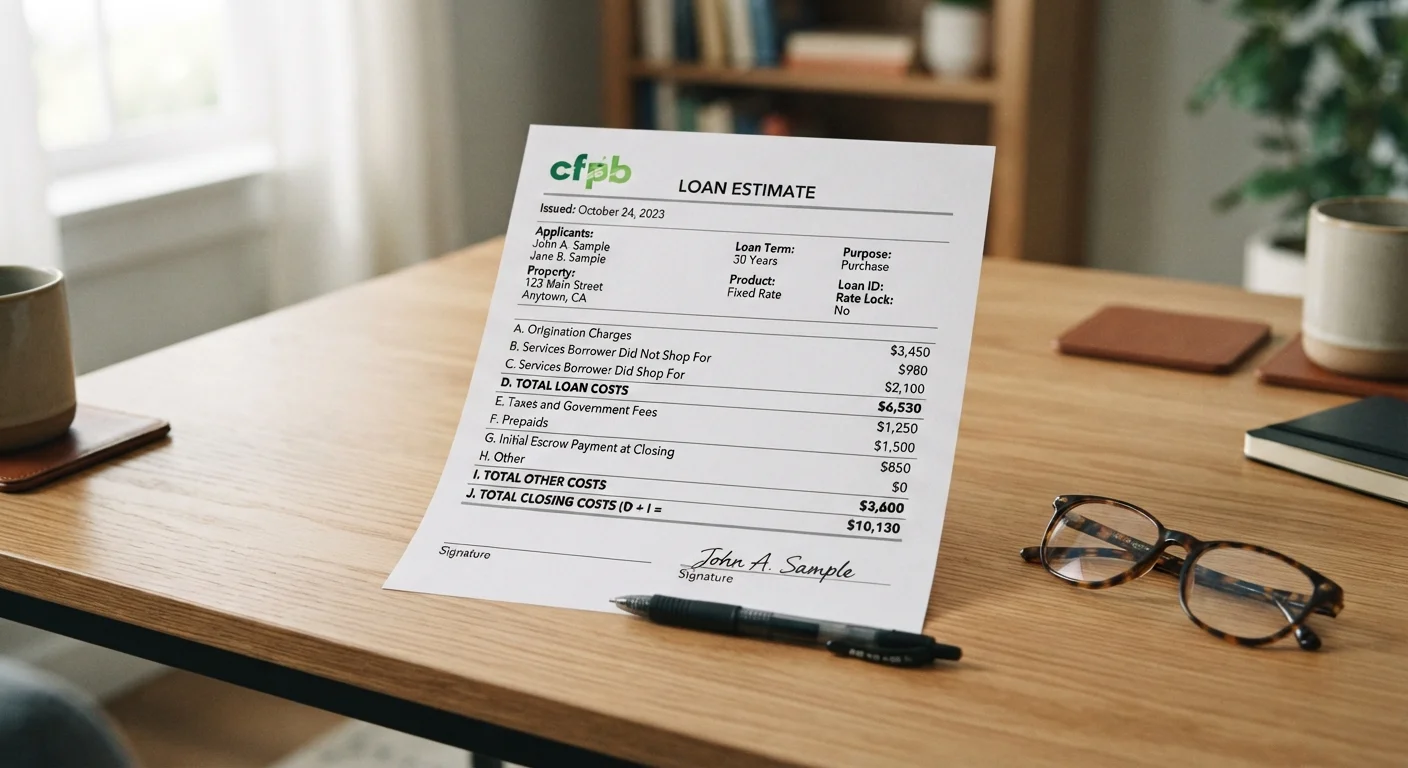
Photo: BridgeWish.com | Reliable Source Of Information editorial
Key Takeaways
- Lenders must issue a Loan Estimate within three business days of receiving your mortgage application.
- The form is standardized under federal TRID rules, so every lender's version uses the same layout and terms.
- Page 1 shows your loan basics; Page 2 breaks down all closing costs; Page 3 reveals comparisons and contact details.
- Some closing cost categories are locked; others can change before closing — knowing which is which protects you.
- Comparing Loan Estimates from multiple lenders on the same day gives you the most accurate side-by-side comparison.
What Is a Loan Estimate and Why It Matters
When you apply for a mortgage, federal law — specifically the TRID rule (TILA-RESPA Integrated Disclosure) — requires your lender to send you a standardized three-page form called the Loan Estimate within three business days. Its purpose is to give you a clear, comparable snapshot of the loan terms and estimated costs before you commit to anything.
Because every lender uses the same layout, you can place two Loan Estimates side by side and compare them line by line. That standardization is the form's greatest strength — but the density of the document can still feel overwhelming at first glance. The field-by-field walkthrough below removes that friction.
This article provides general financial information and education, not personalized financial or legal advice. Consult a qualified mortgage professional or housing counselor for guidance specific to your situation.
What you will need
Page 1: Your Loan Terms at a Glance
The top of Page 1 contains basic identifying information: the lender's name, your name, the property address, the sale price, and the date the estimate was issued. Confirm all of these are correct before reading further — an error here can signal a data-entry mistake that could cause problems later.
Below that, the Loan Terms table is the most important section on the page. Here is what each field means:
- Loan Amount: The total you are borrowing, not including your down payment.
- Interest Rate: The annual rate used to calculate your monthly interest charge. Check whether a "Yes" or "No" box is checked next to "Can this amount increase after closing?"
- Monthly Principal & Interest: The portion of your payment that reduces your balance and covers interest. It does not include taxes or insurance.
- Prepayment Penalty: If checked "Yes," you may owe a fee for paying off the loan early. Most conventional loans do not carry this penalty, but verify.
- Balloon Payment: If checked "Yes," a large lump sum will be due at a set point. This is rare in standard 30-year mortgages but worth confirming.
The Projected Payments table below the Loan Terms section shows your estimated full monthly payment — principal and interest plus estimated escrow for property taxes and homeowners insurance. This is the number closest to what you will actually pay each month.
Request Estimates on the Same Day
Page 2: Closing Costs Line by Line
Page 2 is the most detailed section, listing every anticipated cost to close the loan. It is divided into two main columns: Closing Cost Details and a column showing which party pays each fee.
Section A — Origination Charges
These are fees the lender charges directly for making the loan — things like origination fees, underwriting fees, and discount points (an upfront payment to buy down your interest rate). These figures are locked: the lender cannot increase them before closing.
Section B — Services You Cannot Shop For
Third-party services the lender requires and selects, such as the appraisal, credit report, and flood determination. These can increase slightly but are generally stable.
Section C — Services You Can Shop For
Required services where you are permitted to choose your own provider — most commonly title search, title insurance, and settlement or closing services. Shopping around here can save hundreds of dollars. If you use a provider from the lender's approved list, these fees are also locked.
Sections E, F, G, H — Prepaids, Escrow, and Other Costs
Section E (Prepaids) covers costs paid in advance at closing: prepaid interest (from closing day to your first payment), homeowners insurance premium, and property taxes. Section F (Initial Escrow Payment) is the cushion deposited into your escrow account at closing to cover future tax and insurance bills. These figures depend on your closing date and local tax rates, so they can change.
The bottom of Page 2 shows Closing Cost Subtotals and your Cash to Close — the total amount you need to bring to the closing table, including your down payment minus any earnest money already paid.
Watch for Changed Circumstances
Page 3: Comparisons, Contact Info, and Confirm Before You Sign
Page 3 contains three useful tools often overlooked by first-time readers.
Comparisons table: This shows the total cost of the loan in three time horizons — the Annual Percentage Rate (APR), the total interest paid over the life of the loan, and the total principal, interest, and mortgage insurance paid in five years. The APR is broader than the interest rate: it folds in certain fees, making it a better number for comparing loans from different lenders.
For context on how lenders evaluate borrowers in similar ways across loan types, see how your credit report feeds into these decisions before your application.
Other Considerations: This section discloses whether the lender intends to transfer (sell) your loan to another servicer after closing, whether late payments are charged a penalty, and whether the loan has any assumptions provisions.
Confirm Receipt box: You will be asked to sign acknowledging receipt. Signing does not obligate you to take the loan — it only confirms you received the document.
Signing Does Not Lock You In
How to Use Loan Estimates to Compare Lenders
Request Loan Estimates from at least two or three lenders on the same day and for the same loan scenario (same loan amount, property, and down payment). Because rates and fees can shift daily, same-day requests give you the most accurate comparison.
When comparing, focus on: the interest rate and APR together (a low rate with high fees can be more expensive overall), the Origination Charges in Section A (fully locked and entirely within the lender's control), and the Cash to Close figure. Differences in Section C are partly within your control — shop for those services independently.
If something on the estimate is unclear, ask the lender to explain it in writing before you proceed. You have at least 10 business days to decide whether to move forward after receiving the Loan Estimate.
Once you decide to proceed, your lender will eventually issue a Closing Disclosure — a parallel document with final numbers. At that point, compare it carefully against your Loan Estimate. Some cost increases are permitted; others are not. Flagging discrepancies early gives you time to address them before closing day.
The content on this site is for informational purposes only and is not a substitute for professional advice. Always consult a qualified professional for guidance specific to your situation.