
Why Your HVAC Filter Actually Matters More Than You Think

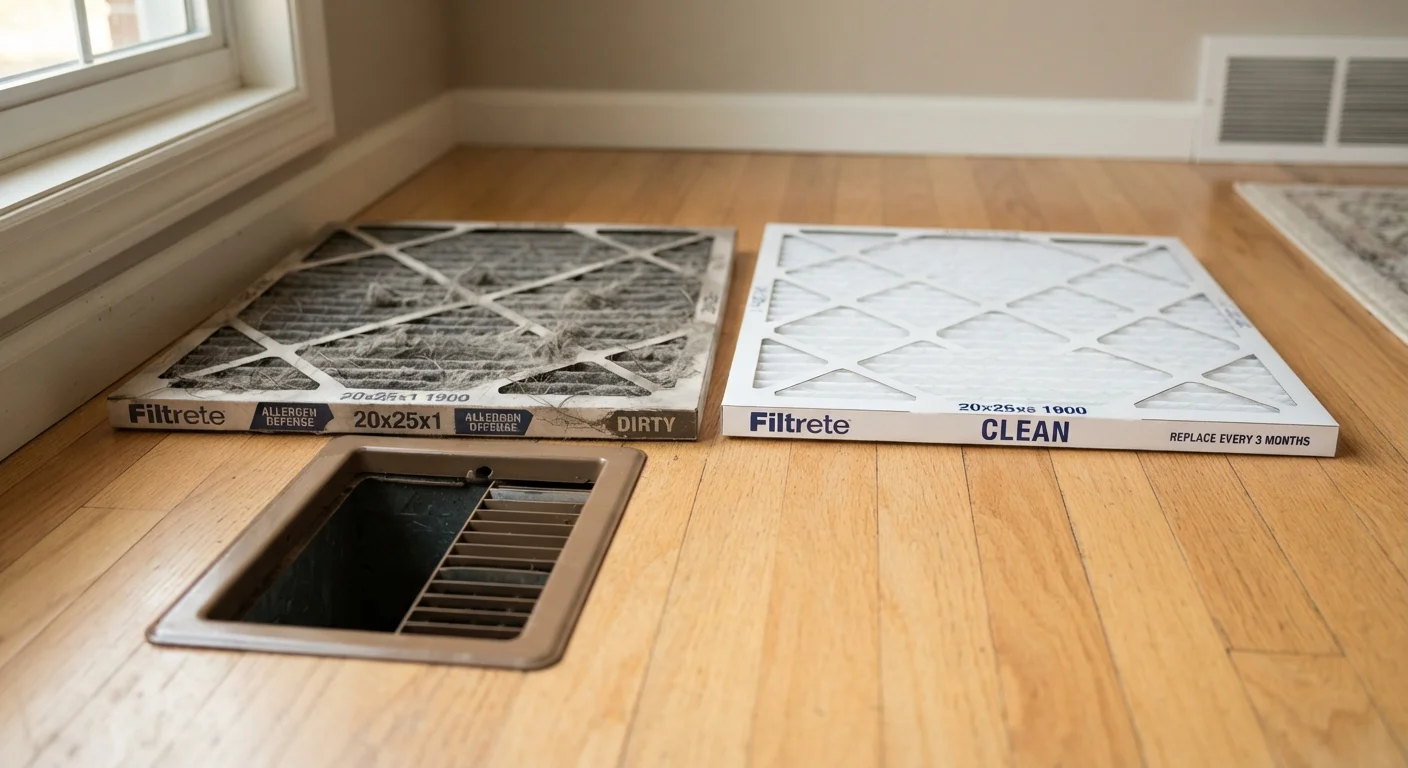
Photo: BridgeWish.com | Reliable Source Of Information editorial
Key Takeaways
- A clogged filter forces your HVAC system to work harder, raising energy bills and shortening system lifespan.
- Using a filter with too high a MERV rating for your system can restrict airflow and cause damage.
- Most homes need a filter change every 1–3 months, depending on pets, allergies, and household size.
- Neglected filters are a leading cause of preventable HVAC repairs and early system failure.
- Filter maintenance is one of the few HVAC tasks most homeowners can safely handle themselves.
The Filter's Real Job — And Why It's Easy to Overlook
Most homeowners think of the HVAC filter as purely an air-quality tool — something to reduce sneezing. In reality, its primary engineering purpose is to protect the system itself. The blower motor, evaporator coil, and heat exchanger all depend on clean, unrestricted airflow to function correctly. When the filter clogs, that airflow drops, and every downstream component pays the price.
Because filters are tucked behind a vent grille or near the air handler — out of sight, out of mind — they're one of the most routinely skipped maintenance items in American homes. This makes them a surprisingly significant source of preventable HVAC repairs. As part of a broader approach to home upkeep, filter maintenance fits naturally into a seasonal routine; the annual home maintenance calendar is a useful framework for scheduling it alongside other tasks.
5–15%
Potential energy savings from a clean filter
The U.S. Department of Energy estimates that replacing a clogged air filter can reduce HVAC energy consumption by roughly 5–15%.
1–3 months
Recommended filter replacement interval
Most HVAC manufacturers recommend changing residential filters every one to three months depending on household conditions like pets and allergies.
MERV 8–11
Recommended range for most homes
Industry guidance generally positions MERV 8–11 as the appropriate balance of filtration efficiency and airflow for standard residential HVAC systems.
What a Clogged Filter Actually Does to Your System
When airflow through the filter is restricted, the HVAC system must work significantly harder to move conditioned air through your home. This has a cascade of consequences:
- Higher energy use: The blower motor runs longer and draws more power trying to compensate for reduced airflow.
- Frozen evaporator coil: In cooling mode, reduced airflow across the coil can cause it to drop below freezing, leading to ice buildup and a system shutdown.
- Overheating: In heating mode, restricted airflow can cause the heat exchanger to overheat, triggering safety shutoffs or, over time, cracking — a serious and expensive failure.
- Dusty coils: Particles that bypass or leak around a saturated filter settle on the evaporator coil, insulating it and reducing its ability to transfer heat efficiently.
These aren't worst-case scenarios reserved for years of neglect — some effects begin within weeks of a filter becoming fully loaded. The relationship between filters, coils, and airflow is worth understanding in detail if you want to protect your system long-term.
Set a Simple Reminder, Not a Fixed Schedule
Choosing the Right Filter — MERV Ratings Explained
Not all filters are interchangeable. The MERV scale rates how effectively a filter captures particles of different sizes. A MERV 1–4 filter — the inexpensive fiberglass kind — catches large debris but misses fine dust, pollen, and pet dander. A MERV 8–11 pleated filter is the standard recommendation for most homes: it traps a meaningful range of particles without overworking the blower.
The common mistake is assuming that a higher MERV is always better. Filters rated MERV 13 and above are engineered for commercial HVAC systems with powerful blowers. Installed in a standard residential unit, they act like a partial blockage — creating the same restrictive effects as a dirty filter, even when brand new. Always cross-reference the filter rating with your system's specifications or consult an HVAC technician before upgrading.
Size matters just as much as rating. The dimensions are printed on the filter's cardboard frame. Using the wrong size leaves gaps around the edges, allowing unfiltered air — and particles — to bypass the media entirely.
Washable Filters: A Different Set of Rules
How to Know When It's Time to Change Your Filter
Manufacturers typically recommend filter changes every 30 to 90 days, but that range reflects very different household conditions. Use these practical signals rather than relying on the calendar alone:
- Visual check: Pull the filter and hold it up to light. A new filter is bright white or light gray. A filter ready for replacement is visibly dark, dense with particulate, or has a thick gray coating.
- Airflow at vents: If supply vents seem to be pushing less air than usual, a clogged filter is a likely culprit.
- Dustier surfaces: Increased dust accumulation on furniture and shelves near vents can indicate that the filter is no longer capturing particles effectively — or that air is bypassing it.
- Rising energy bills: An unexplained increase in heating or cooling costs, with no change in usage habits, is worth investigating with a filter check as the first step.
It's worth noting that this principle applies beyond HVAC — common home maintenance myths often involve skipping regular, low-cost upkeep that prevents far more expensive problems later.
This article is for general informational and educational purposes only. For concerns about your specific HVAC system, consult a licensed HVAC technician in your area.
Frequently Asked Questions
The content on this site is for informational purposes only and is not a substitute for professional advice. Always consult a qualified professional for guidance specific to your situation.