
Fixed vs. Variable Expenses: Understanding the Building Blocks of Any Budget

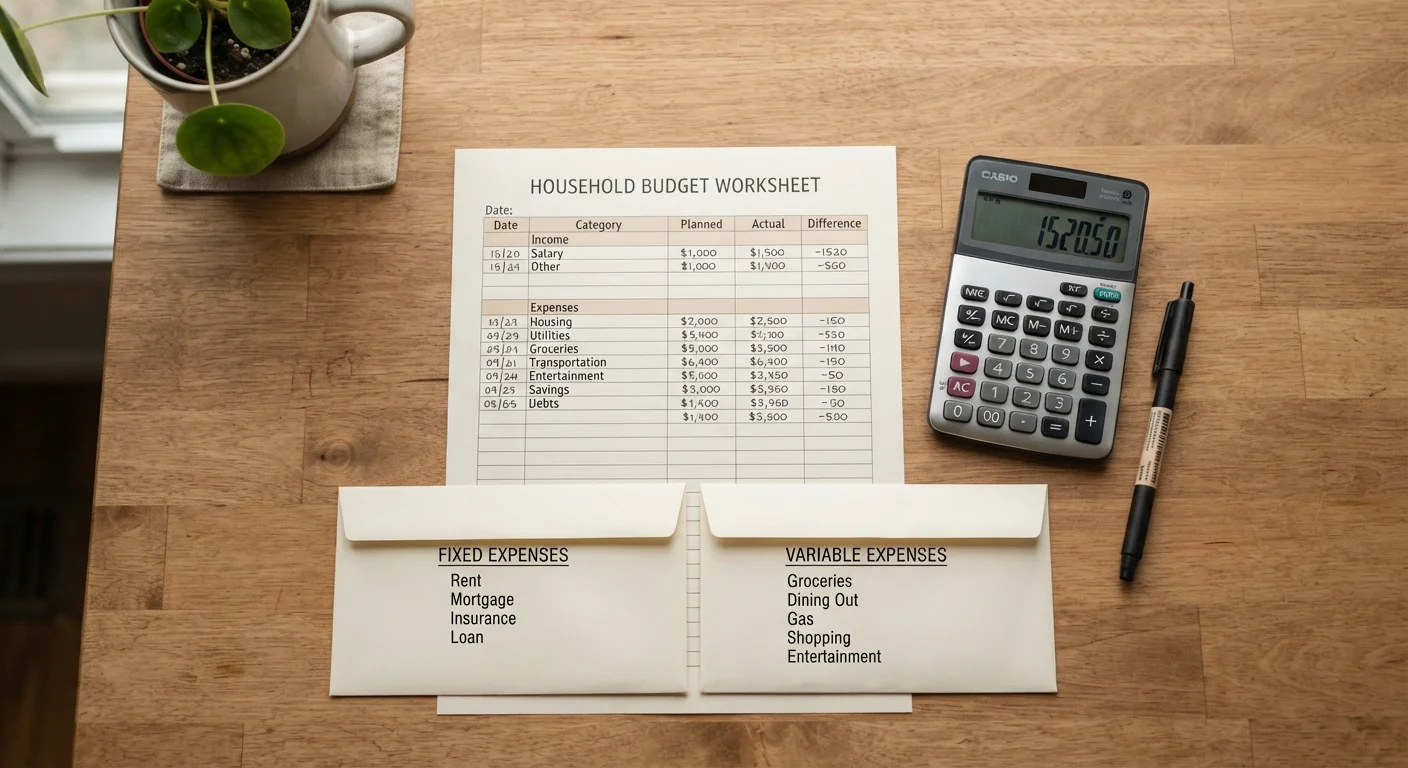
Photo: BridgeWish.com | Reliable Source Of Information editorial
Key Takeaways
- Fixed expenses stay the same each month and are harder to reduce in the short term.
- Variable expenses fluctuate and give you the most immediate control over spending.
- Mapping both categories before budgeting reveals your true financial baseline.
- Most households carry a mix of fixed and variable costs that require different strategies.
- Reducing variable expenses is usually faster; lowering fixed costs takes deliberate planning.
What Makes an Expense Fixed or Variable?
Every dollar that leaves your household falls into one of two categories. A fixed expense is a cost that stays the same amount from month to month - your rent or mortgage payment, a car loan, a health insurance premium, or a fixed-rate utility contract. You've committed to these amounts, often through a lease or loan agreement, so they don't change based on behavior.
A variable expense changes based on usage, choices, or circumstances. Groceries, gas, restaurant meals, clothing, and entertainment are classic examples. The category exists every month, but the dollar amount shifts depending on what you do. Some costs - like a utility bill that varies by season - sit in a middle ground sometimes called semi-variable, though most personal budgets treat them as variable for simplicity.
Before building any spending plan, it helps to brush up on the foundational vocabulary. Our plain-language budgeting glossary covers terms like discretionary spending and net income that appear throughout any budget conversation.
| Criterion | Fixed Expenses | Variable Expenses |
|---|---|---|
| Amount each month | Stays the same | Fluctuates with behavior |
| Common examples | Rent, loan payments, insurance | Groceries, gas, dining out |
| Short-term control | Limited - contractually set | High - adjustable month to month |
| Budget role | Establishes spending floor | Determines spending flexibility |
| Reduction strategy | Renegotiate, refinance, or eliminate | Habit changes, tracking, category caps |
| Risk if income drops | Higher - must still be paid | Lower - can cut back quickly |
How Each Type Shapes Your Monthly Budget
Fixed expenses are the load-bearing walls of your budget. They establish a floor - the minimum you'll spend regardless of how careful or frugal you are that month. Most financial educators recommend listing all fixed costs first when building a budget, precisely because they're non-negotiable in the near term.
Variable expenses, by contrast, are where most day-to-day financial decisions happen. They're also where most budgets slip - not because of any single splurge, but through dozens of small, unconsidered choices. This is both the challenge and the opportunity: variable spending is the most responsive lever available to households trying to free up cash.
~33%
Income spent on housing for typical US renter
The U.S. Bureau of Labor Statistics Consumer Expenditure Survey consistently shows housing as the largest single fixed cost for most American households.
~15%
Share of household spending on food
Food - split between groceries and dining out - represents one of the largest variable expense categories for US consumers, according to BLS data.
3-6 months
Emergency fund target in fixed expenses
Many personal finance frameworks recommend an emergency fund sized to cover three to six months of fixed obligations, not total spending.
Understanding the split also matters when life changes. If you take on a new fixed obligation - say, a car payment - your budget's floor rises permanently until that obligation ends. Variable spending, on the other hand, can be dialed back relatively quickly when income drops or a savings goal demands it. Our guide to how this distinction changes the way you budget explores the practical implications in more depth.
Common Examples and Where Costs Often Blur
Most households carry a recognizable mix of both types. Fixed costs typically include rent or mortgage, loan repayments, insurance premiums, and subscription services at a set monthly rate. Variable costs include fuel, groceries, dining out, personal care, and entertainment.
The blurring happens in a few predictable places. Utilities are a common source of confusion - the bill arrives monthly, but the amount fluctuates with temperature, usage, and rate changes. A cell phone plan with a flat base rate plus per-usage charges combines both. For budgeting purposes, treating these as variable (using a realistic average or a high-end estimate) tends to produce more accurate forecasts than assigning a fixed number.
Housing costs are worth a separate note. Rent paid under a fixed-term lease is a clear fixed expense. If you're weighing lease types, our comparison of month-to-month vs. fixed-term leases shows how flexibility and cost stability trade off. A mortgage with a fixed interest rate behaves similarly - though property taxes and insurance can add variability. See fixed-rate vs. adjustable-rate mortgages for how loan structure affects that monthly figure.
When a Fixed Cost Becomes Variable Over Time
Putting Both Categories to Work in Your Budget
The most practical approach is sequential: list and total all fixed expenses first, subtract that from your monthly take-home income, then allocate what remains across variable categories and savings. This prevents the common mistake of budgeting variable spending before accounting for obligations already locked in.
For variable categories, setting a per-category ceiling - rather than one lump discretionary number - gives you more visibility into where money actually goes. Tracking actual spending against those ceilings for two or three months often reveals patterns that no amount of intention-setting will surface on its own.
If you're ready to build a complete plan, our guide to building a budget that reflects your real life walks through the full process, including how to handle irregular income and infrequent costs. And once your baseline is stable, the Saving & Goals hub offers guidance on turning freed-up cash into progress toward specific financial milestones.
This article is for general informational and educational purposes only and does not constitute personalized financial advice. For guidance specific to your situation, consider consulting a qualified financial professional.
The content on this site is for informational purposes only and is not a substitute for professional advice. Always consult a qualified professional for guidance specific to your situation.