
Debt Settlement, Consolidation, and Bankruptcy: An Honest Comparison

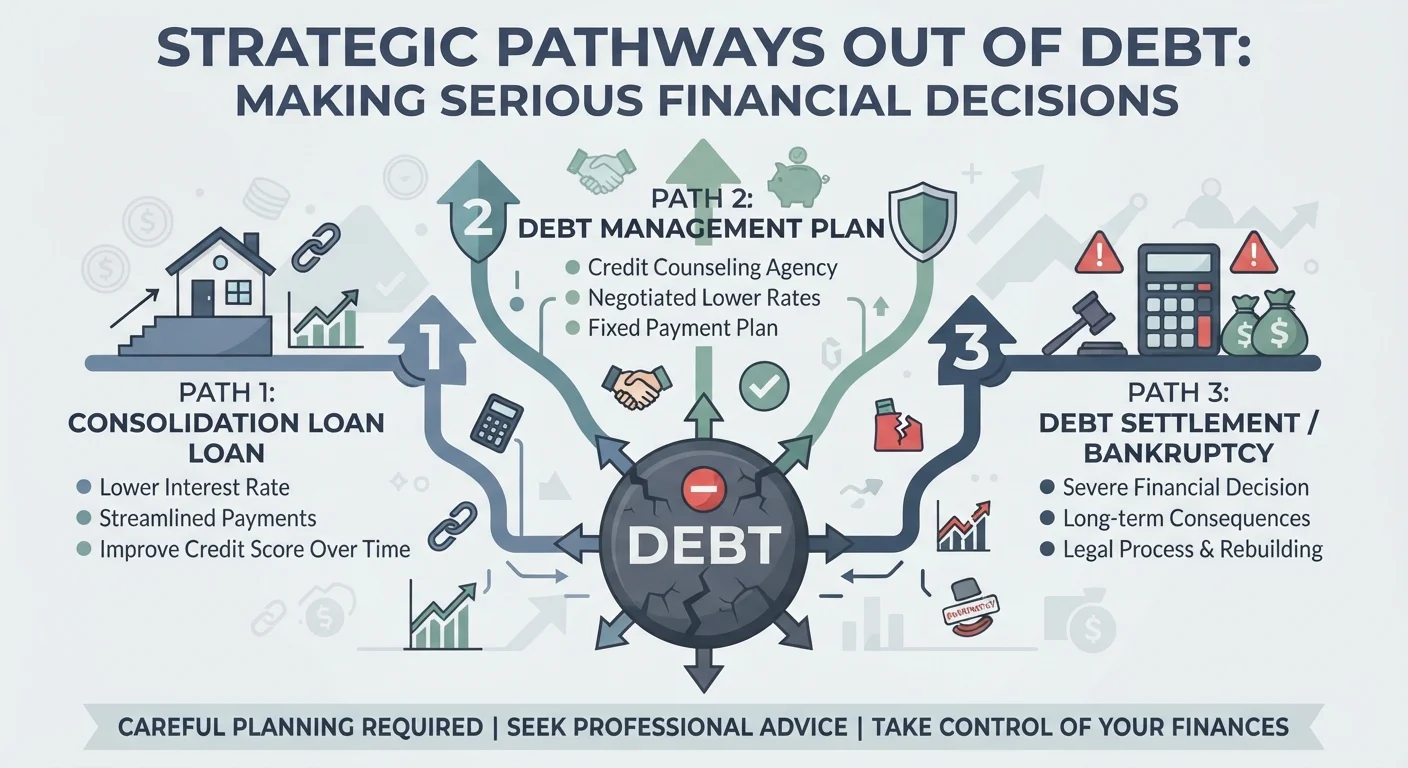
Photo: BridgeWish.com | Reliable Source Of Information editorial
Key Takeaways
- Debt consolidation combines multiple debts into one payment but does not reduce the principal you owe.
- Debt settlement can reduce total principal owed but typically harms your credit score significantly.
- Bankruptcy offers a legal fresh start but carries long-lasting credit and public-record consequences.
- The right option depends on your debt type, income, credit standing, and financial goals.
- All three approaches carry real costs - there is no penalty-free path out of serious debt.
How Each Option Actually Works
These three terms are frequently grouped together, but they operate through fundamentally different mechanisms. Getting them confused can lead to costly missteps.
Debt consolidation means combining multiple debts - typically unsecured ones like credit cards or personal loans - into a single new loan or balance-transfer product. You still owe the full principal; you're restructuring how you repay it, ideally at a lower interest rate. For a fuller breakdown, see what debt consolidation does and doesn't do.
Debt settlement involves negotiating with creditors to accept a lump-sum payment that is less than the total balance owed. You stop making regular payments, allow accounts to become delinquent, and then negotiate - either directly or through a for-profit settlement company - once the creditor is motivated to recover something rather than nothing. The forgiven portion is generally treated as taxable income by the IRS.
Bankruptcy is a federal legal process. Chapter 7 liquidates non-exempt assets to discharge most unsecured debts. Chapter 13 restructures debt into a court-supervised repayment plan over three to five years. Not all debts - such as most student loans, child support, or recent taxes - are dischargeable. Understanding how secured vs. unsecured debt works is essential before evaluating either bankruptcy chapter.
| Debt Consolidation | Debt Settlement | Bankruptcy | |
|---|---|---|---|
| Principal reduced? | No | Yes (partial) | Yes (most unsecured debt) |
| Credit score impact | Minimal to moderate | Severe | Severe |
| Credit report duration | Varies (account history) | 7 years | 7-10 years |
| Requires court process? | No | No | Yes |
| Tax consequences? | Generally none | Forgiven debt may be taxable | Generally none on discharged debt |
| Stops collections? | No | No | Yes (automatic stay) |
| Typical timeline | 2-5 years repayment | 2-4 years | 3-6 months (Ch.7); 3-5 yrs (Ch.13) |
Credit Impact and Timeline
All three options affect your credit profile, but the severity and duration differ markedly.
Consolidation, when handled through a personal loan or balance transfer, may cause a temporary dip from a hard credit inquiry. Over time, consistent on-time payments on the new account can actually improve your score - provided you don't accumulate new balances on the cleared cards.
Settlement causes significant damage. Accounts typically go delinquent for months before a settlement is reached, and each missed payment is recorded. Settled accounts appear on your credit report for seven years from the original delinquency date and are flagged as "settled for less than the full amount."
Bankruptcy carries the longest formal record. A Chapter 7 filing remains on your credit report for ten years; Chapter 13 stays for seven. Both make obtaining new credit difficult in the near term, though many consumers begin rebuilding credit sooner than expected through secured cards or credit-builder loans.
For-Profit Settlement Companies Carry Real Risks
Costs, Fees, and Tax Implications
Each path has direct and indirect financial costs that are often underestimated.
15-25%
Typical debt settlement company fee
The Federal Trade Commission notes for-profit debt settlement companies commonly charge 15-25% of enrolled or settled debt as their fee.
10 years
Chapter 7 bankruptcy on credit report
Under the Fair Credit Reporting Act, a Chapter 7 bankruptcy can remain on a consumer's credit report for up to ten years from the filing date.
Consolidation costs vary by vehicle. Balance-transfer cards often carry a 3-5% transfer fee. Personal consolidation loans carry interest - rates depend on creditworthiness. There is no debt reduction, so total interest paid could still be substantial depending on the loan term.
Settlement costs include fees charged by settlement companies - commonly 15-25% of the enrolled debt or the settled amount - plus the tax liability on forgiven debt. The IRS generally treats cancelled debt as ordinary income unless you qualify for an insolvency exclusion (meaning your liabilities exceed your assets at the time of settlement). Consult a tax professional to assess your specific situation.
Bankruptcy costs include court filing fees, mandatory credit counseling fees, and attorney fees, which for Chapter 13 can run several thousand dollars. However, the legal discharge of debt can produce a net financial benefit for those who qualify.
Choosing the Right Framework for Your Situation
No single option fits every household. Key variables include your debt type, income stability, and what you can realistically afford.
If you have a reliable income and your primary problem is high interest rates across several accounts, consolidation may reduce your monthly burden without the credit damage of the alternatives. It works best when it changes behavior - not just structure. Pairing it with a systematic payoff strategy, such as those covered in debt payoff frameworks like the avalanche or snowball methods, can accelerate your progress.
If you're facing genuine hardship - a job loss, medical crisis, or debts that have already gone to collections - and the principal itself is unmanageable, settlement may be worth exploring, with clear eyes about the credit and tax consequences.
Bankruptcy is appropriate when debt is genuinely unmanageable and other paths are closed. The legal protections it provides - including the automatic stay, which halts most collection actions - can offer breathing room that no private negotiation can guarantee.
Start With a Nonprofit Credit Counselor
This article is for general informational purposes only and does not constitute legal, tax, or personalized financial advice. Consult a qualified financial advisor, licensed attorney, or nonprofit credit counselor regarding your specific circumstances.
The content on this site is for informational purposes only and is not a substitute for professional advice. Always consult a qualified professional for guidance specific to your situation.