
Cooking Myths That Home Cooks Still Believe

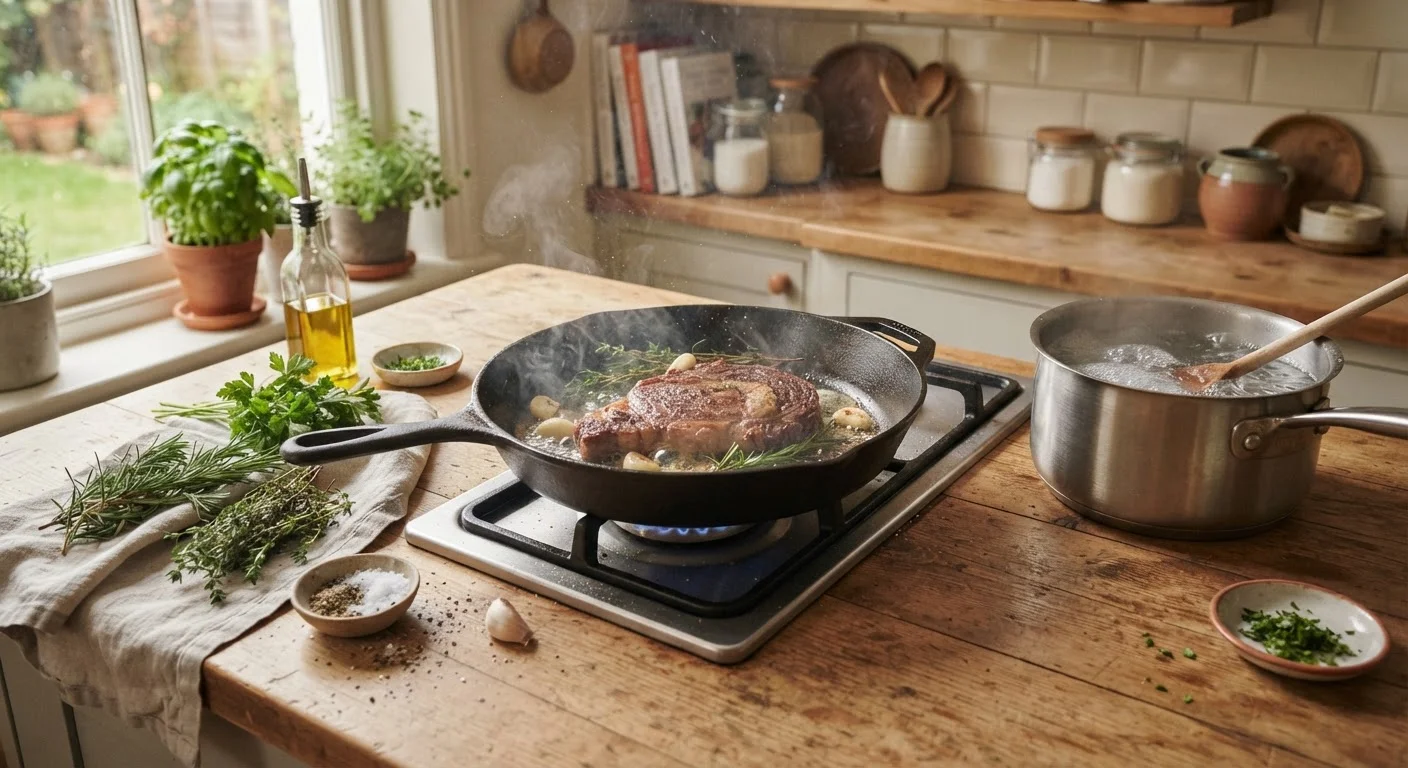
Photo: BridgeWish.com | Reliable Source Of Information editorial
Key Takeaways
- Searing meat does not seal in juices — it creates flavor through browning, not a moisture barrier.
- Adding salt to water raises its boiling point only negligibly; the real benefit is flavor.
- Rinsing cooked pasta removes the starch that helps sauce cling to noodles.
- A sharp knife is safer than a dull one because it requires less force and stays on course.
- Rare chicken is not safe to eat — poultry must reach 165°F to eliminate harmful pathogens.
Why Kitchen Myths Are So Sticky
Cooking lore travels fast — from grandparents to grandchildren, cooking shows to comment sections. Many of these passed-down rules feel true because they're repeated confidently and because kitchens reward consistency. But confidence and repetition aren't the same as accuracy. Food science research, much of it conducted over the past few decades, has quietly overturned a surprising number of these beliefs.
Understanding why a technique works (or doesn't) makes you a more adaptable cook. When you know the actual mechanism — the chemistry, the physics, the biology — you stop following rules blindly and start making better decisions in real time. For a deeper look at how misinformation travels in food culture, see our examination of common nutrition myths.
Myth
Searing meat seals in the juices, keeping it moist.
Fact
Searing does not create a moisture-sealing crust. It develops flavor through the Maillard reaction — a chemical browning process — not a physical barrier.
This myth has circulated since the 19th century, popularized by the chemist Justus von Liebig. Later food scientists, including those who have tested the claim with careful measurement, found that seared cuts actually lose about the same amount of moisture as unseared ones. What searing does deliver is a complex, deeply browned crust packed with hundreds of flavor compounds created when proteins and sugars react to high heat. That's reason enough to sear — just not the reason most cooks think.
Myth
Adding salt to water makes it boil significantly faster.
Fact
Salt does raise water's boiling point, but by such a small amount at kitchen quantities that the timing difference is negligible. Salt's real purpose in pasta water is flavor.
Dissolved salt elevates boiling point through a phenomenon called boiling point elevation, but the effect at culinary concentrations — even heavily salted pasta water — amounts to less than one degree Fahrenheit. At that scale, the difference in boiling time is essentially undetectable. What salt genuinely does is season the pasta from the inside out as it absorbs water during cooking. A well-salted pot of pasta water is one of the simplest, highest-impact seasoning moves in the kitchen.
Myth
You should rinse pasta after cooking to keep it from sticking.
Fact
Rinsing removes the surface starch that helps sauce adhere to pasta. Skipping the rinse — and reserving some pasta water — produces better-sauced dishes.
When pasta cooks, it releases starch into the water and retains a starchy surface layer. That layer acts as a natural glue between noodle and sauce. Rinsing strips it away, leaving slick pasta that sauce slides off of rather than clings to. Reserved pasta cooking water, which is rich in that same dissolved starch, is also a professional technique for adjusting sauce consistency without diluting flavor. The only time rinsing makes sense is for cold pasta salads, where you want to stop cooking quickly and prevent clumping in a dish where sauce adhesion isn't the goal.
Myth
A dull knife is safer than a sharp one because it's less likely to cut you.
Fact
Dull knives are actually more dangerous. They require more force to cut, making them more likely to slip off food and onto fingers.
A sharp knife bites into food cleanly and moves predictably through it. A dull knife skids across surfaces — particularly rounded ones like tomatoes or onions — and the extra pressure a cook must apply means any slip carries significantly more force. Professional cooks and culinary educators consistently emphasize knife sharpening as a safety skill, not just a performance one. A well-maintained knife edge, honed regularly and sharpened periodically, is one of the most practical investments a home cook can make.
Myth
You can tell when chicken is done by checking if the juices run clear.
Fact
Juice color is not a reliable indicator of doneness or food safety. An instant-read thermometer is the only accurate way to confirm chicken is safe to eat.
Poultry must reach an internal temperature of 165°F (74°C) to ensure that pathogens like Salmonella are eliminated — this is the guideline established by the USDA. Juice color depends on factors including the age of the bird, the cut, and how quickly it was chilled after slaughter. Chicken can run clear before reaching a safe temperature, and it can still appear slightly pink at the bone even when fully safe. Relying on color alone creates unnecessary food safety risk. An inexpensive instant-read thermometer removes the guesswork entirely.
What These Corrections Mean for Your Everyday Cooking
Letting go of a myth doesn't mean unlearning everything. Most of the techniques built around these beliefs still produce decent results — they just work for different reasons than cooks assumed. Searing still belongs in your repertoire; you're just doing it for crust and flavor, not moisture retention. Salting pasta water is still excellent practice; you're doing it for taste, not boiling speed.
Food Safety Isn't a Place to Wing It
The real payoff of understanding cooking science is flexibility. When you know that sauce clings because of pasta starch, you stop rinsing — and you might also save a splash of that cooking water to loosen a too-thick sauce. When you know a sharp knife stays on task, you invest in a whetstone. Small corrections, grounded in how food actually behaves, compound into noticeably better meals. For more on how heat transforms ingredients at each stage, explore how cooking methods change the same ingredient. And for seasoning that goes beyond the myths, tasting as you go is the habit worth building next.
The content on this site is for informational purposes only and is not a substitute for professional advice. Always consult a qualified professional for guidance specific to your situation.