
Whole Foods vs. Ultra-Processed Foods: What Sets Them Apart

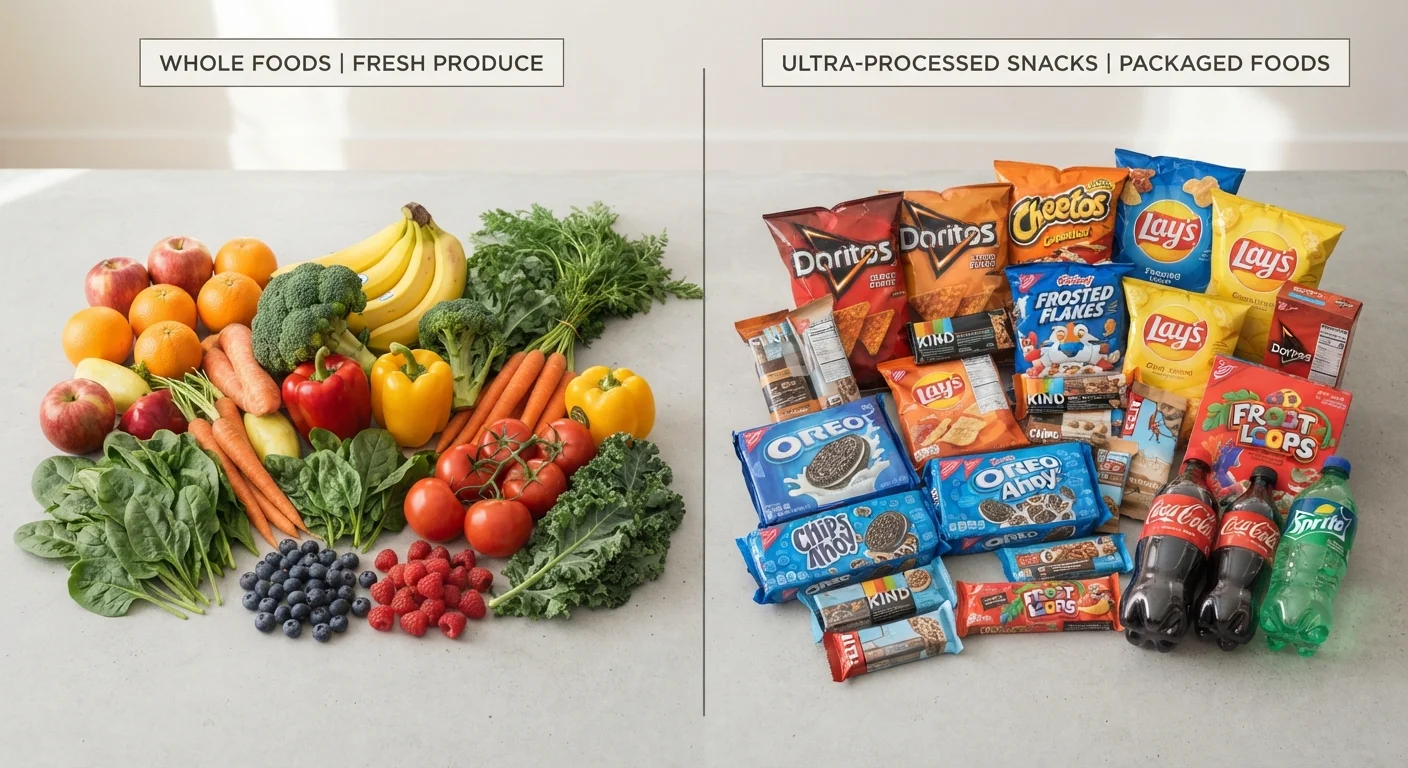
Photo: BridgeWish.com | Reliable Source Of Information editorial
Key Takeaways
- Whole foods are minimally altered and retain most of their original nutrients and fiber.
- Ultra-processed foods are industrially formulated with additives, flavorings, and little whole-food content.
- The NOVA classification system — not a simple processed/unprocessed binary — is how researchers categorize foods.
- Regular high intake of ultra-processed foods is associated with poorer diet quality in population studies.
- Most diets include some processed food; the degree of processing is what matters most for health.
- Reading ingredient lists is one of the most practical tools for identifying ultra-processed products.
Defining the Two Ends of the Food Spectrum
The terms "whole food" and "ultra-processed food" are not just marketing language — they describe meaningfully different categories in nutrition science. Whole foods are those that are close to their natural state: an apple, a handful of walnuts, a fillet of fish, a cup of dried lentils. They may be washed, cut, or cooked, but their fundamental structure and nutrient profile remain largely intact.
Ultra-processed foods sit at the opposite end. Researchers use the term to describe industrially manufactured products assembled mostly from ingredients extracted or derived from foods — such as refined starches, hydrogenated oils, protein isolates, and high-fructose corn syrup — then combined with additives like artificial flavors, emulsifiers, and colorings. The final product often bears little resemblance to any recognizable ingredient.
The most widely used academic framework for drawing this line is the NOVA classification system, developed by researchers at the University of São Paulo. NOVA sorts foods into four groups: unprocessed or minimally processed foods, processed culinary ingredients, processed foods, and ultra-processed food and drink products. The distinction isn't simply "packaged vs. fresh" — it's about the nature and extent of industrial transformation.
| Criterion | Whole Foods | Ultra-Processed Foods |
|---|---|---|
| Definition | Unprocessed or minimally altered from natural state | Industrially formulated with extracted or synthetic ingredients |
| Typical ingredients | One or few recognizable food ingredients | Refined starches, added sugars, oils, additives, flavorings |
| Fiber content | Generally high, naturally occurring | Often low; fiber stripped during refining |
| Micronutrient density | Vitamins and minerals largely intact | Often low; may be partially fortified |
| Added sugars & sodium | Naturally low or absent | Frequently elevated to enhance palatability |
| Shelf life | Shorter; depends on natural state | Extended via preservatives and packaging |
| Examples | Oats, lentils, apples, eggs, salmon | Packaged chips, soda, flavored instant noodles, nuggets |
| NOVA classification | Group 1 (minimally processed) | Group 4 (ultra-processed) |
What Gets Lost — and Added — Through Processing
Processing isn't inherently bad. Freezing spinach, fermenting cabbage into sauerkraut, or stone-milling oats into rolled oats are all forms of processing that preserve or even enhance nutritional value. The concern with ultra-processing is what it systematically removes and what it introduces.
When whole grains are refined into white flour, the bran and germ layers — where fiber, B vitamins, and minerals concentrate — are stripped away. Learn exactly what milling removes from grain and how that affects blood sugar response. Ultra-processed products often go further, recombining refined flour with added sugars, fats, and sodium at levels rarely found in whole foods.
The additive load also matters. Emulsifiers help shelf-stable products maintain texture; artificial flavors compensate for taste lost during industrial refining; preservatives extend shelf life far beyond what any whole food naturally offers. While individual additives approved for use in the US are assessed for safety by the FDA, their combined effects at the population level remain an active area of research.
~57%
Share of US calories from ultra-processed foods
Research published in BMJ Open estimated that ultra-processed foods account for roughly 57% of daily caloric intake among US adults.
4 groups
NOVA food classification categories
The NOVA framework, developed at the University of São Paulo, classifies all foods into four groups based on the degree and purpose of processing.
~90%
Of US added sugar intake from ultra-processed foods
Studies using NHANES data suggest the vast majority of added sugars in the American diet come from ultra-processed food and drink products.
How to Spot Ultra-Processed Foods in Practice
The ingredient list is your most reliable tool. A product is likely ultra-processed when it contains substances you wouldn't find in a home kitchen: maltodextrin, sodium stearoyl lactylate, carrageenan, or "natural flavors" listed alongside a string of chemical-sounding names. The more a label reads like a chemistry glossary, the further the product sits from its whole-food origin.
Common ultra-processed categories include: packaged snack chips and crackers, carbonated soft drinks and energy drinks, flavored instant noodles, most fast-food items, packaged sweet baked goods, and reconstituted meat products like nuggets and hot dogs. Conversely, plain yogurt (even if jarred), canned tomatoes, frozen edamame, and nut butters with only one or two ingredients are processed but not ultra-processed.
Decoding nutrition labels in detail can sharpen your ability to evaluate any packaged product quickly. Look at ingredient order (listed by weight, heaviest first), added sugar disclosures, and sodium content relative to the serving size.
Not All Packaged Food Is Ultra-Processed
Why the Distinction Matters for Your Diet
A substantial body of observational research associates frequent ultra-processed food consumption with lower overall diet quality and lower intake of key nutrients like fiber, potassium, and magnesium. These associations don't prove direct causation on their own — diet is complex, and people who eat more ultra-processed foods may differ in many other lifestyle factors — but the consistency of findings across multiple countries and populations is notable.
The practical implication isn't that all ultra-processed food is forbidden or that every meal must be built from scratch. Rather, understanding the spectrum helps you make deliberate, proportional choices. A diet anchored in whole and minimally processed foods — vegetables, fruits, legumes, whole grains, eggs, fish, plain dairy — with occasional ultra-processed items is a reasonable goal for most adults. For core principles of balanced eating beyond this single dimension, consider how variety and overall dietary patterns matter alongside any one food category.
This article is for general informational and educational purposes only and is not a substitute for personalized nutrition or medical advice. Consult a registered dietitian or qualified healthcare professional for guidance specific to your health needs.
The content on this site is for informational purposes only and is not a substitute for professional advice. Always consult a qualified professional for guidance specific to your situation.