
Whole Grains vs. Refined Grains: What Changes When Grain Is Processed

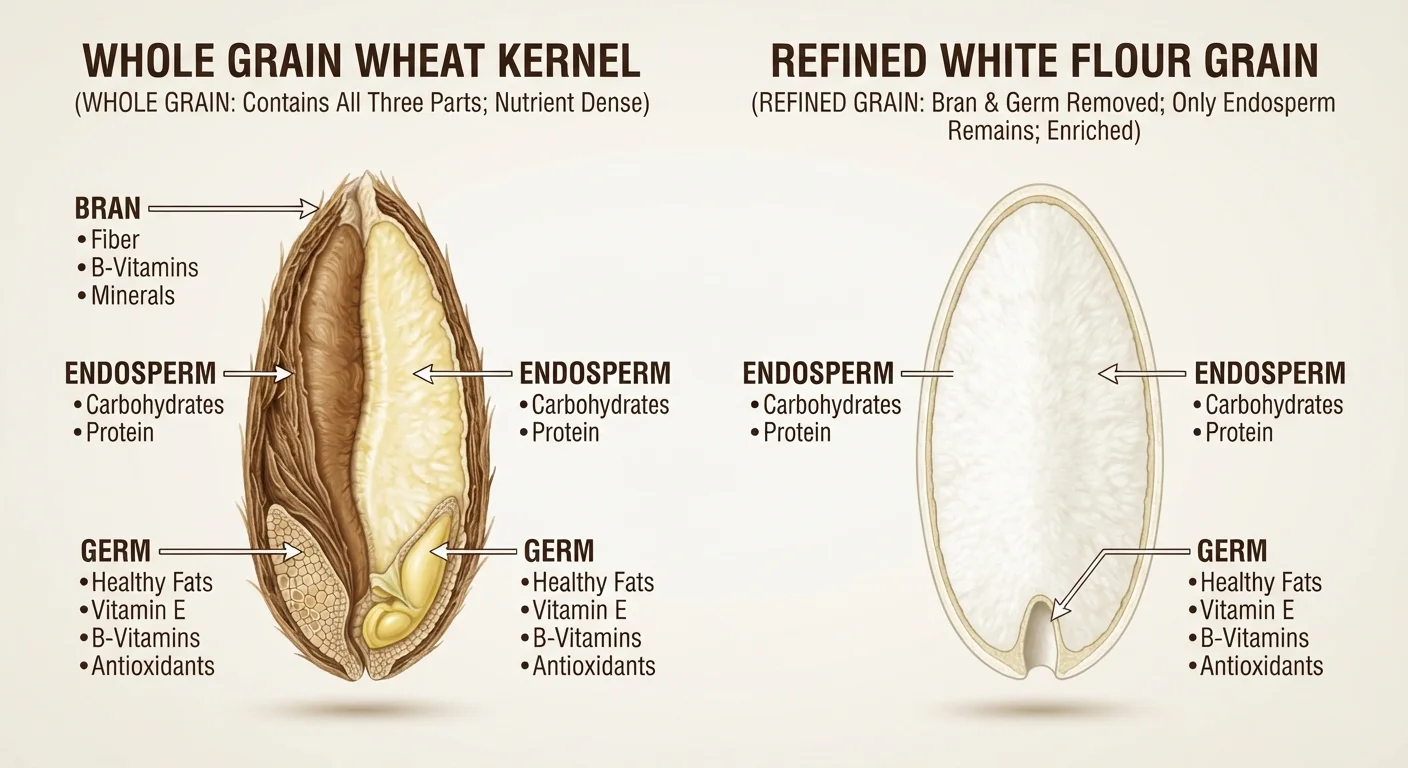
Photo: BridgeWish.com | Reliable Source Of Information editorial
Key Takeaways
- Milling removes the bran and germ, stripping away fiber, B vitamins, and healthy fats.
- Refined grains digest faster, which raises blood sugar more quickly than whole grain equivalents.
- Enriched refined grains have some B vitamins added back, but fiber and many micronutrients are not restored.
- Most US dietary guidelines recommend making at least half of daily grain servings whole grains.
- Reading ingredient labels carefully is the most reliable way to identify a true whole grain product.
What Happens Inside the Mill
Every grain — wheat, oats, rice, corn — shares the same three-part structure: the bran (tough outer layer), the germ (nutrient-rich embryo), and the endosperm (starchy interior). A whole grain keeps all three intact. Refining — specifically the milling process — strips away the bran and germ, leaving almost entirely endosperm.
That distinction matters nutritionally because the bran and germ carry the majority of the grain's fiber, B vitamins (thiamine, niacin, folate, B6), vitamin E, iron, magnesium, and healthy unsaturated fats. The endosperm is mostly starch with modest protein and very little of the above. When those outer layers are removed, the nutritional profile of the grain changes substantially.
| Criterion | Whole Grains | Refined Grains |
|---|---|---|
| Grain layers retained | Bran, germ, endosperm | Endosperm only |
| Dietary fiber | High | Low |
| B vitamins (natural) | Significant amounts | Mostly removed; some added back |
| Magnesium & zinc | Present | Largely removed |
| Blood sugar response (GI) | Lower / slower | Higher / faster |
| Shelf life | Shorter (oils in germ go rancid) | Longer |
| Texture in baking | Denser, heartier | Lighter, finer |
Fiber, Blood Sugar, and Why the Difference Shows Up in Your Body
Fiber is the most consequential nutrient lost during refining. Dietary fiber slows the rate at which carbohydrates are broken down and absorbed. When that buffer is removed — as in white bread versus whole wheat bread — glucose enters the bloodstream faster, producing a sharper blood sugar spike and a quicker return of hunger.
This is captured in the concept of the glycemic index (GI), which ranks foods by how quickly they raise blood glucose. Whole grain foods consistently score lower on this scale than their refined counterparts. For example, whole wheat bread generally has a lower GI than white bread made from the same wheat. Over time, patterns of high-GI eating are associated in population studies with higher risk of type 2 diabetes and cardiovascular disease, though individual response to specific foods varies considerably.
25%
Fiber lost when wheat is refined to white flour
According to USDA nutrient data, refining whole wheat to white flour removes roughly 75–80% of its dietary fiber.
≥50%
Recommended share of daily grains that should be whole grains
The Dietary Guidelines for Americans advise that at least half of all grain servings consumed daily come from whole grain sources.
It is also worth noting that "enriched" refined grains — the standard for most US white flour and white rice — have certain B vitamins (thiamin, riboflavin, niacin, folic acid) and iron added back after milling. Enrichment has meaningfully reduced deficiency diseases like beriberi and pellagra. However, fiber, magnesium, vitamin E, and dozens of phytochemicals are not restored through enrichment, so the nutritional gap between enriched refined grains and true whole grains remains real.
How to Actually Identify a Whole Grain Product
Marketing language on packaging can be misleading. Words like "multigrain," "stone-ground," "100% wheat," or "made with whole grain" do not guarantee a product is primarily whole grain. The most reliable method is reading the ingredient list: the first ingredient should name a whole grain explicitly — "whole wheat flour," "whole oat flour," "brown rice," or "whole grain corn."
The Whole Grain Stamp issued by the Whole Grains Council provides a shortcut — the "100% Whole Grain" stamp indicates all grain ingredients are whole grain — but not every legitimate whole grain product carries it, so label-reading remains the gold standard.
"Multigrain" Does Not Mean Whole Grain
For context on how grain processing fits into the broader food environment, see our discussion of whole foods vs. ultra-processed foods and our guide on whole foods vs. processed foods — both explore how levels of processing affect nutritional value across food categories, not just grains.
This article is for general informational and educational purposes only. It is not a substitute for personalized nutrition or medical advice. Consult a registered dietitian or qualified healthcare provider for guidance specific to your health needs.
The content on this site is for informational purposes only and is not a substitute for professional advice. Always consult a qualified professional for guidance specific to your situation.