
Bodyweight Training vs. Free Weights: Choosing the Right Fit for Your Goals

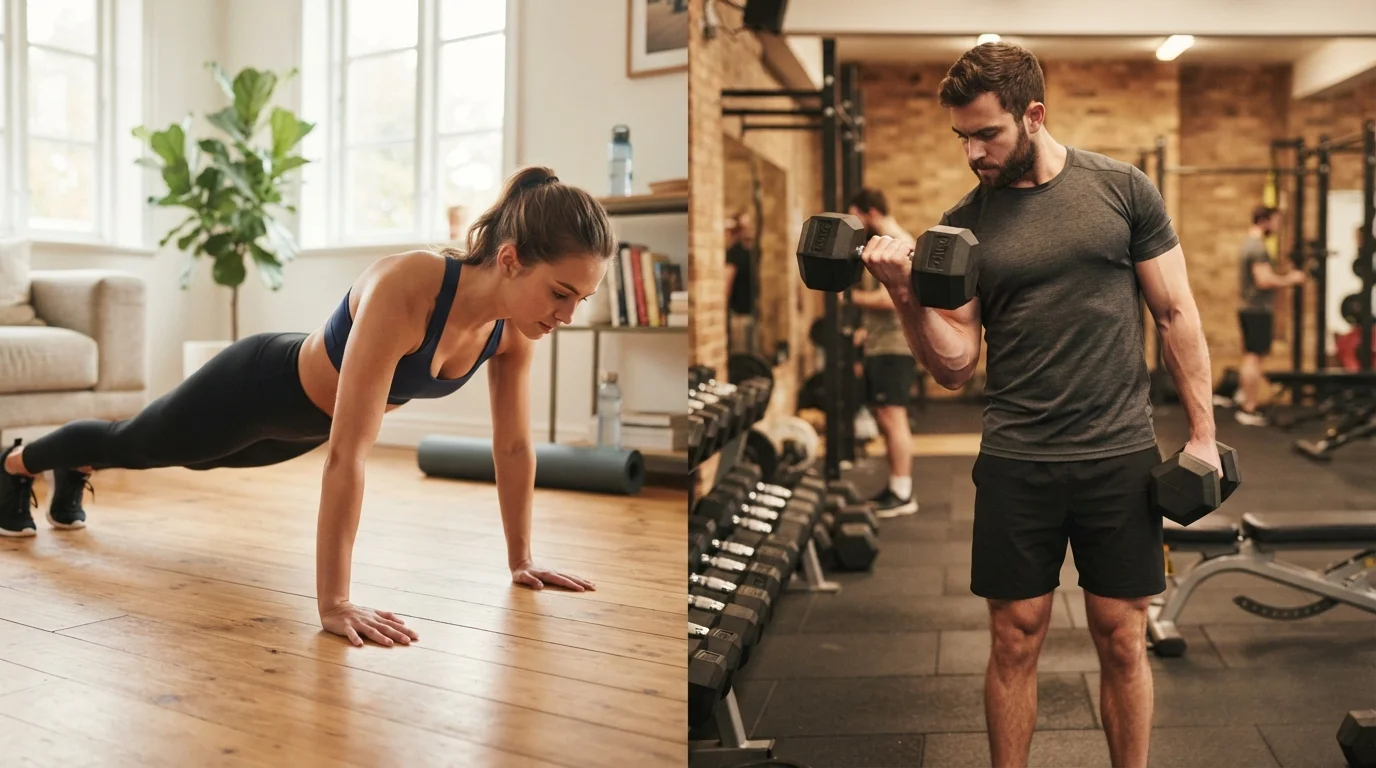
Photo: BridgeWish.com | Reliable Source Of Information editorial
Key Takeaways
- Bodyweight training requires no equipment and can be done anywhere, making it highly accessible for beginners.
- Free weights allow precise load increases, making progressive overload easier to track and sustain over time.
- Both methods can build meaningful strength and muscle when programmed consistently and with good form.
- Cost and space are practical factors: bodyweight training is essentially free, while free weights require some investment.
- Many people benefit from combining both approaches rather than committing exclusively to one.
What Each Training Style Actually Involves
Bodyweight training uses your own body as resistance — think push-ups, pull-ups, lunges, squats, dips, and planks. No barbells, no gym required. Free weights, by contrast, include dumbbells, barbells, and kettlebells — tools that let you add external load to movements and adjust resistance with precision.
Both methods are forms of resistance training. Understanding the core principles of strength training — progressive overload, recovery, and rep ranges — applies equally to both. The difference lies in how you apply those principles.
Bodyweight training excels at building relative strength (strength relative to your body mass), coordination, and joint stability. Free weights excel at absolute load progression — you can add five pounds to a dumbbell curl far more easily than you can make a push-up five pounds harder.
Strength Gains, Muscle, and Progressive Overload
Progressive overload — gradually increasing training stress over time — is the key driver of both strength and muscle development. Free weights make this straightforward: add a small plate, move up a dumbbell size, or increase reps with the same weight. The feedback is clear and measurable.
Bodyweight training can achieve progressive overload, but it requires more creativity. You progress by changing leverage (feet-elevated push-ups), reducing base of support (single-leg squats), slowing tempo, or adding explosive variations. These are legitimate strategies, though they can feel less intuitive for beginners.
~Equal
Muscle gains: bodyweight vs. free weights
Research suggests comparable hypertrophy outcomes when training volume and effort are matched across both modalities.
$0
Minimum cost to start bodyweight training
No equipment is needed — foundational bodyweight movements require only floor space and consistent effort.
73%
US adults who don't meet strength training guidelines
According to the CDC, most American adults do not perform muscle-strengthening activities on the recommended two or more days per week.
Research consistently shows that both modalities can produce comparable muscle and strength gains when volume, effort, and progressive challenge are matched. A 2019 review published in the Journal of Human Kinetics found no significant difference in upper-body strength outcomes between push-up protocols and bench press protocols when load was equated. That said, free weights offer a clear practical edge for lower-body loading beyond moderate fitness levels — it's simply difficult to load a squat pattern heavily enough with bodyweight alone.
Cost, Convenience, and Accessibility
Bodyweight training costs nothing and fits almost anywhere. This makes it one of the most accessible forms of exercise available, particularly for people without a gym membership or dedicated workout space. If you're exploring building a home routine without equipment, bodyweight movements are the natural starting point.
Free weights carry upfront cost — a basic set of adjustable dumbbells or a few kettlebells can range from modest to significant investment depending on quality. However, once purchased, they are durable and long-lasting. If you're setting up a home training environment, our guide on creating a functional home workout space covers how to do this without overcomplicating it.
| Criterion | Bodyweight Training | Free Weights |
|---|---|---|
| Upfront cost | None required | Moderate to significant |
| Space needed | Minimal — floor space only | Moderate — storage required |
| Progressive overload | Possible but less intuitive | Straightforward and measurable |
| Lower-body loading | Limited at advanced levels | Highly effective at any level |
| Portability | Fully portable | Not portable |
| Learning curve | Low for basics | Moderate — form coaching helps |
| Muscle-building potential | Good, with structured progression | Excellent, especially long-term |
For those who prefer structured social environments, it's also worth weighing group fitness classes versus solo training — accountability and instruction can be as important as equipment choice for long-term consistency.
Which Should You Choose — or Can You Use Both?
The honest answer for most people is: a combination works better than either alone. Bodyweight movements build the movement quality and joint control that make free-weight training safer and more effective. Free weights then allow you to load those patterns in ways bodyweight alone cannot.
If you're choosing just one, lean on your real-world constraints. Limited budget or space? Bodyweight training is an excellent, research-supported option. Committed to long-term strength or muscle development as a primary goal? Free weights offer a more direct path. This decision doesn't have to be permanent — your approach should evolve as your fitness does.
For a broader look at how strength training fits alongside aerobic fitness, see our overview of strength training versus cardio. Whichever method you choose, consistency over months — not the perfect program — is what drives lasting results.
This article is for general informational purposes only and does not constitute medical or fitness advice. Consult a qualified healthcare or fitness professional before beginning a new exercise program, especially if you have any existing health conditions or injuries.
A Note on Injury Risk and Form
The content on this site is for informational purposes only and is not a substitute for professional advice. Always consult a qualified professional for guidance specific to your situation.