
Baking vs. Cooking: Why the Same Instincts Don't Always Transfer

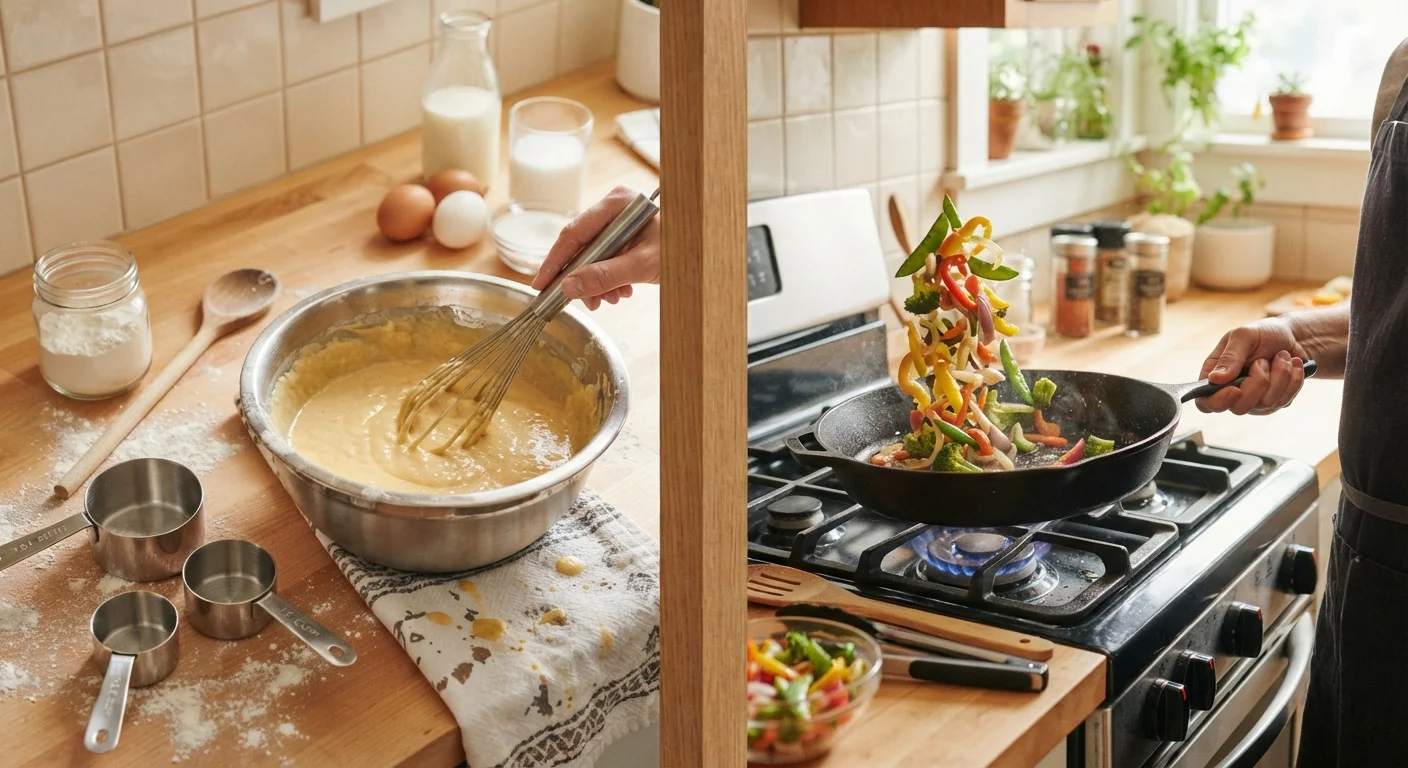
Photo: BridgeWish.com | Reliable Source Of Information editorial
Key Takeaways
- Baking relies on precise ratios and chemical reactions; small measurement errors can meaningfully change the outcome.
- Cooking is more forgiving — experienced cooks taste, adjust, and correct as they go.
- Both skills are learnable, but switching between them requires a deliberate shift in mindset.
- Understanding why each discipline works the way it does makes you more confident in both.
The Core Difference: Chemistry vs. Craft
Both baking and cooking transform raw ingredients into something worth eating — but they operate on fundamentally different principles. Baking is, at its heart, applied chemistry. When flour, fat, liquid, leavening, and eggs combine in specific ratios and hit a specific oven temperature, a predictable set of reactions unfolds: gluten forms structure, leavening gases expand, proteins set, and sugars caramelize. Change one variable meaningfully — too much flour, not enough fat, the wrong oven temperature — and the reaction changes too. The result is a dense cake, a gummy loaf, or cookies that spread flat.
Cooking, by contrast, is more of an ongoing conversation with your ingredients. You're using heat, acid, fat, salt, and time to develop flavor and texture, but you can intervene at almost any point. If your sauce is too salty, add acid or more liquid. If your vegetables are browning too fast, lower the flame. See our guide to tasting as you go for why this mid-process adjustment is one of the most valuable habits a cook can build.
| Criterion | Baking | Cooking |
|---|---|---|
| Precision required | High — measurements are critical | Moderate — adjustments are easy |
| Mid-process correction | Limited once in the oven | Possible at almost any stage |
| Heat control | Indirect, ambient (oven) | Direct, adjustable (stove, grill) |
| Ingredient substitution | Risky without chemistry knowledge | Generally more forgiving |
| Skill that transfers in | Patience and attention to detail | Sensory judgment and improvisation |
| Failure recovery | Often difficult or impossible | Frequently achievable |
Why Instincts Built in the Kitchen Can Mislead You in the Bakery
Experienced home cooks often run into trouble when they apply their stovetop instincts to baking. A confident cook knows that a recipe is a starting point — they'll add a pinch more spice, substitute one acid for another, or eyeball quantities with confidence. That flexibility is genuinely useful at the stove. But carry it into baking without understanding the underlying chemistry, and things go sideways quickly.
The most common example: adjusting flour or liquid quantities casually. In a soup or stew, adding a splash more broth changes the consistency slightly. In a bread dough, adding extra flour shifts the hydration ratio, which changes gluten development, which affects crumb structure and crust. What looks like a small tweak is actually a structural change. Similarly, substituting baking soda for baking powder — or vice versa — without accounting for the different acid requirements produces very different results, not just a slightly altered one.
1:1 swap
Baking soda vs. baking powder equivalency myth
Baking soda is roughly three times stronger than baking powder, and it requires an acid in the recipe to activate — they are not interchangeable in equal amounts.
25°F+
Common home oven temperature variance
Consumer oven testing has consistently found that many home ovens run 25°F or more off from their displayed setting, making an oven thermometer a practical tool for bakers.
This doesn't mean baking recipes are rigid for no reason. The precision exists because the process is irreversible in a way that cooking usually isn't. You can't un-set a collapsed soufflé. Understanding this helps you respect measurements in baking while still exercising appropriate judgment.
Heat Behaves Differently Too
One of the clearest practical divides is how heat works in each discipline. In stovetop cooking, heat is direct, immediate, and adjustable. You can see and hear what's happening — the sizzle, the color change, the steam — and respond in real time. Pan temperature is one of the most important variables in cooking, and learning to read it gives you significant control over your results.
In baking, heat is indirect and ambient — it comes from all sides inside a closed oven. You can't stir, taste, or correct once the door closes. Oven calibration matters: many home ovens run hotter or cooler than their displays indicate, which is why an oven thermometer is a small but genuinely useful tool. Rack position affects how heat reaches your food — a tray of cookies on the top rack will brown faster on top; on the bottom rack, the base cooks more aggressively.
For a broader look at how heat transforms ingredients depending on the method used, see our explainer on dry heat vs. moist heat cooking.
Convection Settings Change the Equation
Building Confidence in Both
The good news: the skills aren't in opposition. Understanding baking's logic actually makes you a better cook, because it teaches you to think carefully about ratios and reactions. And strong cooking instincts help you become a more intuitive baker over time — you develop a feel for what dough should look and feel like, or when a batter is too thick, even before relying entirely on a recipe.
A practical approach is to treat each discipline on its own terms at first. When baking, measure carefully and follow the method before you improvise. When cooking, practice tasting and adjusting throughout rather than waiting until the dish is done. Over time, you'll build a mental model of what each discipline requires — and you'll switch between them with much more confidence.
For more on how to decode what recipes are actually asking of you in either context, our guide to reading a recipe breaks down the language that trips up even experienced home cooks.
The content on this site is for informational purposes only and is not a substitute for professional advice. Always consult a qualified professional for guidance specific to your situation.