
Knife Skills Every Home Cook Should Know

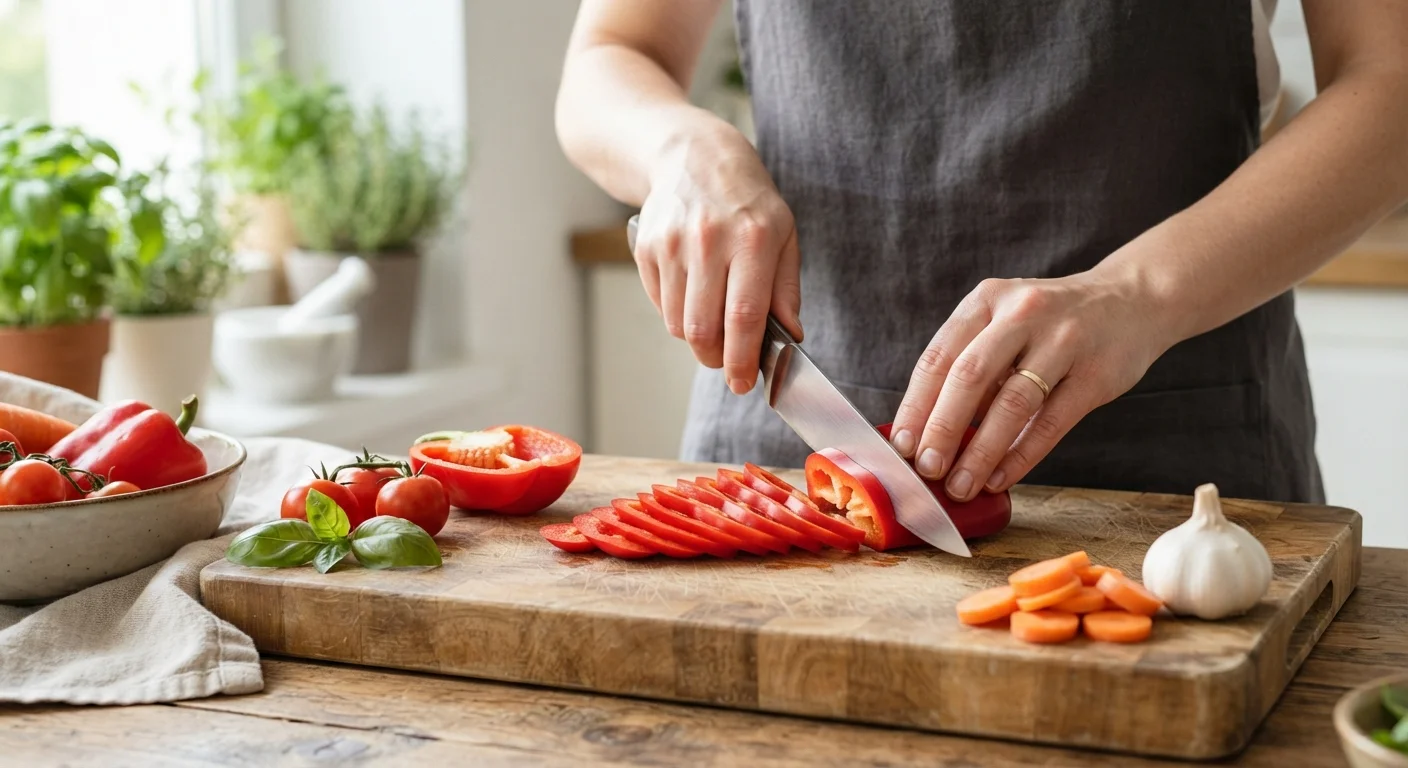
Photo: BridgeWish.com | Reliable Source Of Information editorial
Key Takeaways
- The pinch grip gives you more control and reduces hand fatigue during long prep sessions.
- A small set of cuts — dice, chiffonade, julienne — covers the vast majority of home recipes.
- A sharp knife is safer than a dull one because it requires less force and is more predictable.
- The claw grip protects your fingertips while guiding food through every cut.
- Consistent knife technique speeds up prep and produces more evenly cooked food.
Why Knife Skills Matter More Than Equipment
Many home cooks assume their cooking suffers because they don't have professional-grade tools. In practice, technique almost always matters more than hardware. A cook who understands how to grip, guide, and move a knife will work faster and more safely than one relying on an expensive blade with poor habits.
Good knife skills also directly affect how food cooks. Unevenly cut vegetables — some thick, some thin — will cook at different rates, leaving you with a mix of overdone and underdone pieces in the same pan. Consistent cuts mean consistent results. If you're just building out your kitchen, our guide to essential beginner tools covers what you actually need to get started.
Pinch grip
A knife-holding technique where you pinch the blade itself between your thumb and bent index finger, giving you better control and precision than gripping only the handle.
Claw grip
A way of holding food while cutting — fingertips curled inward so your knuckles face the blade and act as a guide, protecting your fingertips from the cutting edge.
Julienne
A knife cut that produces thin, uniform matchstick-shaped strips, typically used for vegetables in stir-fries or salads.
Chiffonade
A cutting technique for leafy herbs or greens: leaves are stacked, rolled tightly, then sliced into thin ribbons.
Honing
The process of realigning a knife's edge using a honing rod. It doesn't remove metal but keeps the blade performing between sharpenings.
Dice
A cut that produces uniform cubes of food. The size (small, medium, large) affects both appearance and how evenly the food cooks.
How to Hold a Knife Correctly
The two grips worth learning immediately are the pinch grip and the claw grip — one for the knife hand, one for the hand holding the food.
The Pinch Grip (Knife Hand)
Rather than wrapping all four fingers around the handle, pinch the blade itself between your thumb and the side of your bent index finger, right at the point where blade meets handle. Your remaining three fingers hold the handle. This shifts control closer to the blade's center of gravity, giving you far more precision with less effort.
The Claw Grip (Guide Hand)
Curl your fingertips inward on the hand holding the food so that your knuckles face the blade. Your knuckles guide the side of the knife as you cut, and your tucked-in fingertips stay safely out of the blade's path. Practice this on a carrot or potato before speed becomes a goal.
Practice on a Carrot First
The Core Cuts You'll Use Every Day
You don't need to master every classical French cut to cook well at home. These four will cover almost every recipe you encounter:
- Rough chop: Quick, approximate cuts used when precision doesn't affect the outcome — building a stock or a rustic sauce, for example.
- Dice: Even cubes cut in small (about ¼ inch), medium (½ inch), or large (¾ inch) sizes. Start by squaring off your ingredient into planks, then sticks, then cubes.
- Julienne: Thin matchstick strips, typically about ⅛ inch wide. Trim the ingredient into flat planks, then cut those into uniform strips. Common in stir-fries and salads.
- Chiffonade: A technique for leafy herbs and greens. Stack the leaves, roll them into a tight cylinder, then slice across into thin ribbons. Perfect for fresh basil or mint.
Once you're comfortable with your prep, pairing these skills with an organized workspace pays off significantly. The mise en place approach — having everything prepped and in place before cooking — transforms how smoothly a session runs.
Safety Habits That Prevent Accidents
Most knife injuries happen when the blade slips — often because of a rushed movement, a wet hand, or food rolling unexpectedly. A few consistent habits reduce that risk significantly:
- Stabilize your cutting board. Place a damp kitchen towel or non-slip mat underneath. A board that slides is a serious hazard.
- Create a flat surface on round ingredients. Before cutting a potato, onion, or squash, slice a small flat face onto it so it sits stable. Never cut a round object that can roll freely.
- Keep your knife moving forward or down — never toward your body. Always cut away from yourself, and pass a knife to someone handle-first or by setting it on the counter.
- Don't leave a knife in a sink of soapy water. Hidden blades cause cuts. Wash knives individually and set them aside promptly.
Never Catch a Falling Knife
Keeping Your Knife in Working Shape
A sharp knife is objectively safer than a dull one. When a blade is dull, you apply more pressure to force it through food — and when it slips, it travels further and faster. Maintaining your edge reduces both effort and risk.
Honing (using a honing rod) realigns the microscopic edge of the blade and should happen regularly — many cooks do it before each session. It doesn't remove metal; it just straightens the edge back into alignment. Sharpening (on a whetstone or with a pull-through sharpener) actually removes a small amount of metal to create a new edge, and most home cooks need this only a few times a year.
For a deeper look at what these tools do and when to use them, see our guide to knife sharpness and maintenance. Store knives on a magnetic strip or in a knife block — drawer storage dulls edges and increases the chance of reaching in and getting cut.
With the right grip, a handful of reliable cuts, and a well-maintained blade, prep work stops feeling like a hurdle and starts feeling like part of the cooking rhythm. These fundamentals genuinely transfer to every meal you make.
Frequently Asked Questions
The content on this site is for informational purposes only and is not a substitute for professional advice. Always consult a qualified professional for guidance specific to your situation.