
Salt Myths That Are Quietly Ruining Your Cooking

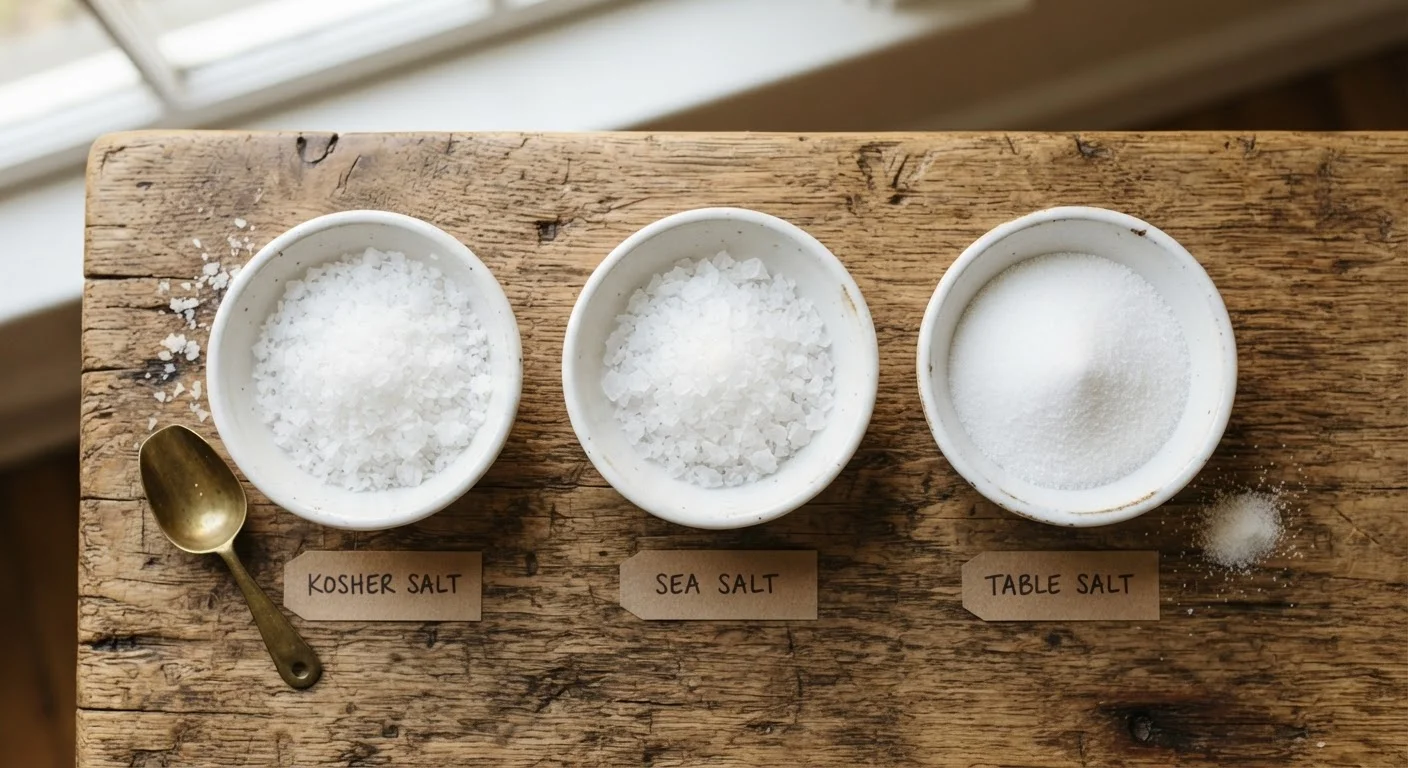
Photo: BridgeWish.com | Reliable Source Of Information editorial
Key Takeaways
- Salt added early enhances flavor more deeply than salt added only at the end.
- Kosher and table salt are not interchangeable by volume — density differences matter significantly.
- Pasta water should taste noticeably salty, not just faintly seasoned, for properly flavored pasta.
- Salt does not meaningfully raise water's boiling point at home-cooking quantities.
- Rinsing salted meat before cooking defeats the purpose of dry-brining.
Why Salt Myths Stick Around
Salt is the single most important seasoning tool in any kitchen, yet it's surrounded by more folklore than almost any other ingredient. Some myths were passed down from cautious home cooks worried about health. Others evolved from half-understood culinary advice. The result is that many cooks under-salt their food, use salt at the wrong stage, or pick the wrong type for the job — and their dishes quietly suffer for it.
Understanding how salt actually works transforms your cooking. It doesn't just make things taste "salty" — it suppresses bitterness, amplifies sweetness, and helps other flavors bloom. For a deeper look at how salt fits into the bigger picture of flavor, see our guide on the four forces behind every good dish. First, let's clear up the myths doing the most damage.
The Most Damaging Salt Myths — Corrected
The myths below show up regularly in home kitchens. Each one leads to a concrete, fixable problem once you know the truth behind it.
Myth
You should only salt food at the end of cooking to avoid drawing out moisture and making it tough.
Fact
Salting early — especially for proteins and vegetables — produces better flavor and texture, not worse.
Early salting gives salt time to penetrate beyond the surface. In meat, this is the principle behind dry-brining: salt draws out a small amount of moisture initially, dissolves in it, and then gets reabsorbed into the muscle fibers, seasoning the interior and helping retain juiciness during cooking. Vegetables that are salted ahead of roasting shed excess water, which actually encourages browning rather than steaming. Salting only at the end delivers seasoning on the surface alone — the flavor never integrates the same way.
Myth
A teaspoon of kosher salt and a teaspoon of table salt are the same thing.
Fact
Kosher salt and table salt have very different densities, so equal volumes deliver very different amounts of sodium.
Table salt has fine, dense crystals that pack tightly — a teaspoon delivers significantly more sodium than the same volume of coarser kosher salt. Diamond Crystal kosher salt, for instance, is roughly half as dense as table salt by volume. Swapping one for the other at a 1:1 ratio without adjusting is one of the most common reasons a recipe turns out either bland or unpalatably over-salted. When following a recipe, use the salt type it specifies, or weigh your salt in grams for reliable results.
Myth
Pasta water should have just a pinch of salt — enough to season slightly.
Fact
Properly salted pasta water should taste pleasantly salty, often described as similar to mild seawater.
Pasta is a starchy, largely flavorless canvas that can only be seasoned from the outside in during the brief window it spends cooking. Under-salted water produces bland pasta that no amount of sauce can fully rescue, because the starch itself carries no flavor. A generous amount of salt — commonly one to two tablespoons per gallon of water, though this varies by personal taste and pasta shape — seasons the pasta throughout as it absorbs water. The pasta does not become overly salty; most of the salted water is discarded.
Myth
Adding salt to water makes it boil significantly faster.
Fact
At the amounts used in home cooking, salt raises water's boiling point by a negligible fraction of a degree.
Dissolved solutes do technically raise water's boiling point — this is a real chemistry principle called boiling point elevation. However, the effect requires solute concentrations far beyond what any cook would add to pasta water. The practical impact at culinary quantities is essentially zero. Salt your pasta water because it seasons the pasta; the boiling speed will be determined by your burner, pot size, and the amount of water, not by the salt.
Myth
Fancy finishing salts like fleur de sel taste the same as regular table salt and are just a marketing gimmick.
Fact
Finishing salts have distinct textures and mineral profiles that genuinely affect the experience of a dish when used correctly.
Finishing salts are not better for seasoning during cooking — their delicate crystal structure dissolves quickly and their nuance disappears with heat. Their value is textural and subtle: a flake of fleur de sel or Maldon on a piece of chocolate, a seared steak, or a sliced tomato delivers a burst of salinity and a satisfying crunch that finer salts cannot replicate. Used at the right moment (just before serving), they earn their place. Used as an all-purpose cooking salt, they're wasteful and the distinction is lost.
~50%
Volume difference between table and Diamond Crystal kosher salt
Culinary educators widely note that Diamond Crystal kosher salt is roughly half as dense by volume as table salt, making direct substitution unreliable without weight measurement.
1–2 tbsp
Typical salt per gallon for pasta water
Many professional cooking references recommend one to two tablespoons of kosher salt per gallon as a starting point for well-seasoned pasta cooking water.
Once these fundamentals click, you'll find yourself reaching for salt with more intention and less anxiety. For more on how to apply seasoning instinctively throughout the cooking process, tasting as you go is the foundational habit to build next.
Putting It Into Practice
Correcting your salt habits doesn't require memorizing rules — it requires shifting a few mental defaults. Season meat and vegetables early. Use kosher salt as your everyday cooking salt and measure by weight when precision matters. Make your pasta water assertively salty. Taste at every stage rather than only at the end.
Don't Rinse Dry-Brined Meat Before Cooking
One note worth keeping in mind: the salt myths discussed here are about cooking technique, not dietary sodium intake. If you have been advised by a healthcare provider to monitor or limit sodium, that guidance takes precedence over any cooking recommendation. General information on salt in cooking is not a substitute for personalized medical advice.
For cooks who want to go further, building flavor without a recipe shows how to put salt, acid, fat, and heat together without needing step-by-step instructions.
This article is for general informational purposes only and does not constitute medical or dietary advice. Consult a qualified healthcare professional for guidance specific to your health needs.
The content on this site is for informational purposes only and is not a substitute for professional advice. Always consult a qualified professional for guidance specific to your situation.