
Group Classes vs. Private Training Sessions for Dogs

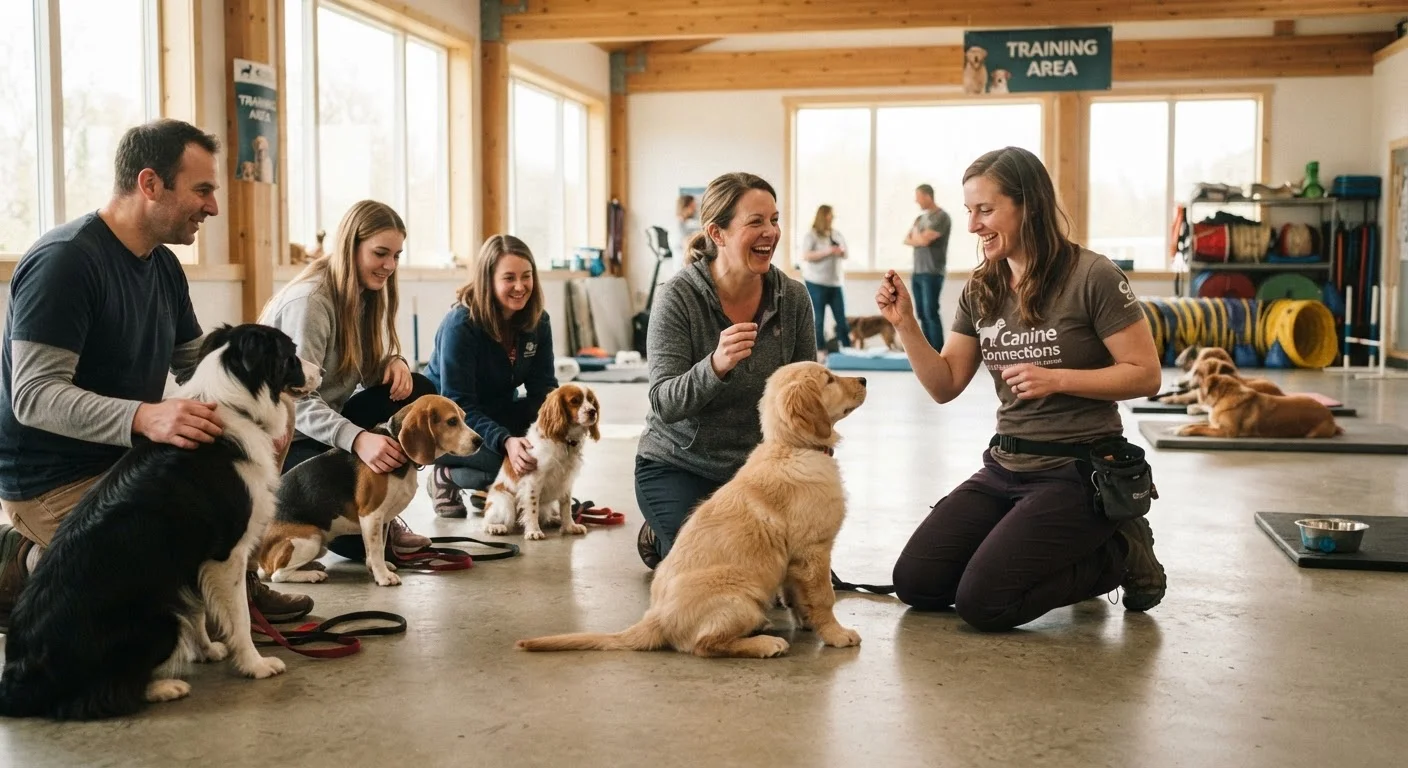
Photo: BridgeWish.com | Reliable Source Of Information editorial
Key Takeaways
- Group classes build real-world social skills and teach dogs to focus around distractions.
- Private sessions allow a trainer to address specific behavioral issues with individualized attention.
- Cost, dog temperament, and training goals are the primary factors guiding the right choice.
- Both formats work best when paired with consistent daily practice at home.
- Fearful, reactive, or newly adopted dogs often benefit most from starting with private sessions.
What Each Format Actually Involves
Group obedience classes typically involve four to twelve dog-owner pairs working together under one trainer's guidance. Sessions run weekly over several weeks and cover foundational skills — sit, stay, recall, loose-leash walking — in a setting full of real-world distractions. That built-in chaos is part of the point.
Private training sessions, by contrast, pair you and your dog one-on-one with a trainer, either at your home, the trainer's facility, or another agreed location. The trainer designs every session around your dog's specific history, temperament, and goals. There's no waiting for other dogs to take their turn, and the curriculum moves at your pace.
For a broader look at how these two formats compare alongside online training programs, see our full comparison of all three training formats.
| Group Classes | Private Sessions | |
|---|---|---|
| Cost | Generally lower per session | Higher; reflects one-on-one time |
| Socialization opportunity | High — built into the format | Low — typically dog and owner only |
| Personalization | Limited; shared curriculum | High; tailored to your dog's needs |
| Best for reactive dogs | Not ideal initially | Well-suited; controlled environment |
| Trainer attention | Shared across the group | Fully focused on you and your dog |
| Distraction training | Built-in naturally | Must be deliberately staged |
| Schedule flexibility | Fixed class times | Often more flexible |
The Case for Group Classes
One of the most underrated benefits of group training is the distraction-rich environment. Teaching a dog to sit in a quiet kitchen is relatively straightforward; teaching that same dog to sit calmly while other dogs mill nearby is genuinely harder — and far more useful in everyday life. Group classes deliver that challenge in a controlled, supervised setting.
Socialization is another major advantage, particularly for puppies. Positive exposure to unfamiliar dogs, people, and stimuli during a dog's developmental window (broadly, the first few months of life) helps build confidence and reduces the likelihood of fear-based reactivity later on.
Group classes also tend to be more affordable than private sessions and carry a community element that many owners find motivating. Seeing other dogs and handlers working through the same challenges normalizes the learning curve and can encourage owners to stay consistent.
Ask About the Trainer's Credentials
The Case for Private Training Sessions
Private training comes into its own when a dog's needs are too specific or complex for a group setting to address effectively. A dog that lunges at other dogs, shows resource guarding, or has a history of trauma may find a group class overwhelming before any learning can occur. A qualified trainer can assess the underlying causes and build a structured, safe plan.
In-home sessions have an added advantage: behavior problems often look different in the dog's own environment. A trainer visiting your home can observe the exact context in which a problem occurs — whether that's door-darting, separation-related distress, or reactivity to street noise — and tailor techniques accordingly.
Private sessions also give owners more uninterrupted coaching time. The trainer can give real-time feedback on your handling, your timing, and your body language — factors that matter enormously in dog training. Understanding the science behind reward-based methods helps here; see our article on positive reinforcement vs. correction-based training for the research underpinning humane approaches.
Choosing Based on Your Dog's Situation
Temperament is the clearest deciding factor. Confident, sociable dogs who haven't developed significant behavioral concerns are well-suited to group classes. Shy, fearful, or reactive dogs typically need the lower-stimulation environment of private work before they're ready to learn alongside others.
Age matters too, though perhaps less than many owners assume. Puppies benefit enormously from supervised group socialization. Older dogs can absolutely learn in either setting — the approach simply needs to be adjusted. Our guide on training an older dog covers what to expect when working with adult and senior animals.
Practical factors — your schedule, proximity to training facilities, and budget — will also shape the decision. Neither format delivers results without your follow-through at home. Whatever training path you choose, building a consistent daily practice is what turns single sessions into lasting behavior change.
This article is for general informational purposes only. For dogs showing serious aggression, significant fear responses, or other complex behavioral challenges, consult a qualified veterinary behaviorist or certified professional dog trainer.
The content on this site is for informational purposes only and is not a substitute for professional advice. Always consult a qualified professional for guidance specific to your situation.