
Speed Limits, Right of Way, and Other Traffic Laws Drivers Routinely Misunderstand

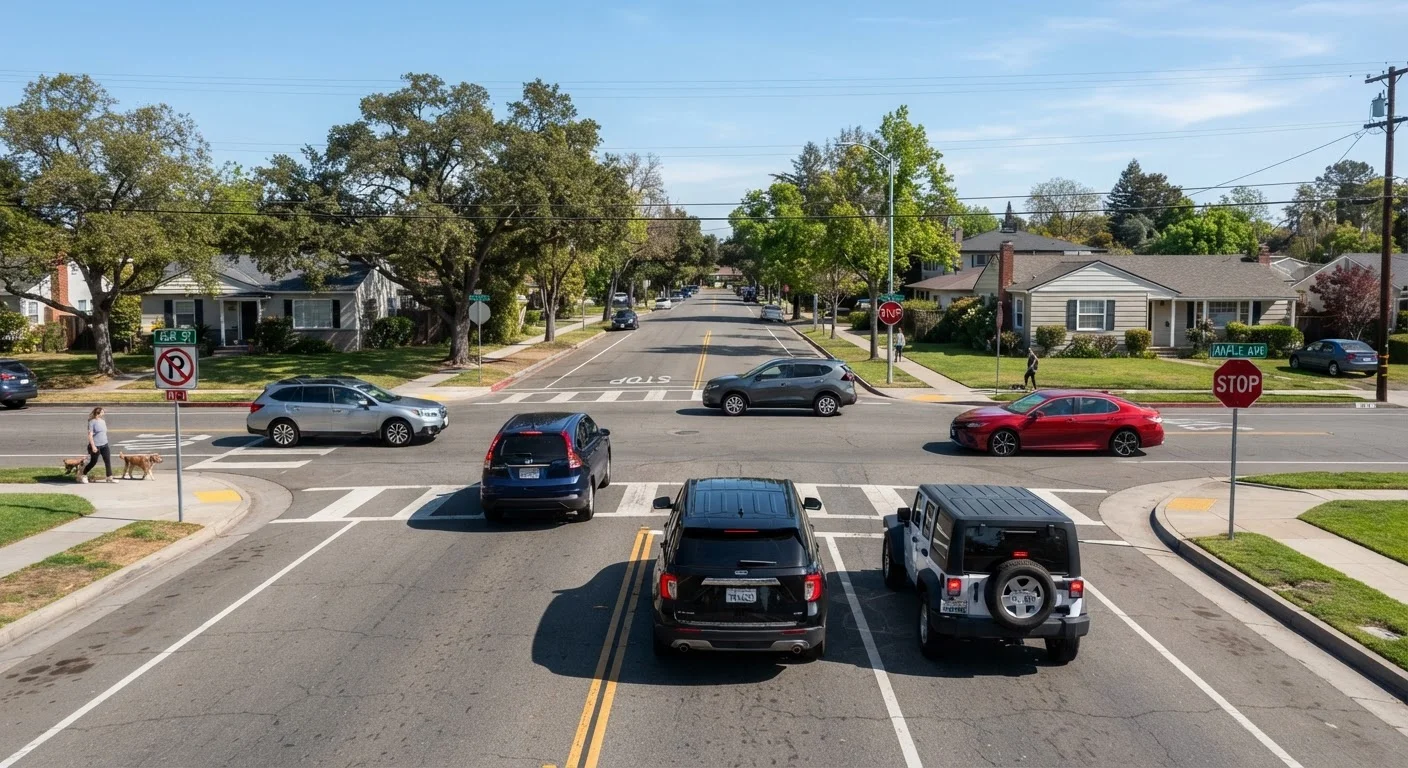
Photo: BridgeWish.com | Reliable Source Of Information editorial
Key Takeaways
- Keeping up with traffic flow does not make speeding legal - the posted limit is the law.
- At a four-way stop, the first vehicle to arrive and stop has the right of way.
- The left-lane passing rule applies on most highways, and camping there is illegal in many states.
- Pedestrians in a crosswalk always have the right of way, whether the crosswalk is marked or not.
- Merging drivers must yield - the vehicle already in the lane is not required to make room.
Why Traffic Law Misunderstandings Are Dangerous
Most drivers passed a written test decades ago and haven't reviewed traffic law since. Over time, informal habits, peer-modeled behavior, and internet folklore fill the gaps left by fading knowledge. The result is a widespread set of plausible-sounding beliefs that are simply wrong - and some of them cause crashes.
Misunderstood rules cluster around a handful of high-conflict situations: intersections, lane usage, speed limits, and pedestrian right of way. These are exactly the moments where two drivers need to agree on who goes first. When they're working from different assumptions, conflict follows. The myth-vs-fact pairs below address the most consequential misconceptions, drawn from state traffic codes and widely documented crash patterns.
For a closer look at how right-of-way confusion plays out at specific intersection types, see where most drivers go wrong on right-of-way.
Myth
If you're driving at the same speed as surrounding traffic, you can't be ticketed for speeding.
Fact
Traffic flow does not override the posted speed limit. An officer can lawfully cite any driver exceeding the limit, regardless of what other vehicles are doing.
The "keeping up with traffic" idea is one of the most durable speed limit myths on the road. In reality, posted limits are statutory maximums - they define the legal ceiling for speed under ideal conditions, not a floor you must match. Driving 75 mph in a 65 mph zone is a violation whether you're surrounded by other speeders or alone on the highway. Officers retain discretion about whom to stop, but that discretion doesn't make speeding legal. See speed limit myths drivers still believe for a deeper breakdown of this and related misconceptions.
Myth
At a four-way stop, the driver on the right always goes first.
Fact
The first vehicle to come to a complete stop has the right of way. The "yield to the right" rule only applies when two vehicles arrive simultaneously.
The right-of-way-to-the-right rule is a tiebreaker, not the primary rule. When vehicles arrive at different times - which is most of the time - the first to stop proceeds first. When two vehicles stop at exactly the same moment, the driver on the left yields to the driver on the right. If three or four vehicles arrive simultaneously, the situation becomes more complex, and cautious communication (eye contact, a hand wave) becomes essential. Treating every four-way stop as a "yield right" scenario leads to unnecessary hesitation and confusion. Navigating intersections safely covers these scenarios in greater detail.
Myth
The left lane is a fast lane - you can drive any speed there as long as you're passing.
Fact
The left lane on multi-lane highways is designated for passing and overtaking. Traveling at any speed in the left lane without actively passing other vehicles is illegal in most states.
Most US states have "keep right" laws requiring drivers to stay in the right lane except when passing. Some states - including Georgia, New Jersey, and Illinois - have enacted specific "left lane laws" that can result in fines for impeding traffic by camping in the passing lane. Driving at the speed limit in the left lane while blocking faster traffic does not protect you legally in those jurisdictions. The left lane is a tool for overtaking, not a preferred cruising lane. Consistent left-lane camping also contributes to unsafe passing maneuvers on the right.
Myth
When merging onto a highway, vehicles already on the highway must let you in.
Fact
The merging driver bears the legal responsibility to yield. Vehicles traveling in the through lane have the right of way.
This misconception causes real friction at on-ramps every day. The legal obligation to yield belongs to the driver entering the roadway, not to the driver already traveling in the established lane. Courteous drivers in the through lane may choose to move over or ease their speed to assist a merge - and in some states, the zipper merge technique is actively encouraged - but this is a courtesy, not a legal requirement. Assuming you'll be let in and forcing a merge is both legally wrong and dangerous. For a detailed look at how merging rules work across different scenarios, see roundabouts, merges, and complex intersections.
Myth
You only need to yield to pedestrians in marked crosswalks.
Fact
Most state laws require drivers to yield to pedestrians at any intersection, including unmarked crosswalks where sidewalks meet - whether painted or not.
An "unmarked crosswalk" is a legal concept recognized in most US states. It refers to the implied pedestrian crossing path at any intersection where sidewalks, paths, or shoulders meet - even if no paint or signage marks the crossing. Drivers who assume pedestrian right of way only applies at painted crosswalks may fail to yield in exactly the situations where pedestrians are most at risk. State traffic codes vary in their specific language, but the general principle is consistent: pedestrians crossing at intersections are entitled to protection whether the crosswalk is visually obvious or not.
Speed Limits, Lane Rules, and Pedestrian Right of Way
Speed and lane discipline are among the most routinely misread areas of traffic law. Many drivers operate on rules they invented, inherited from other drivers, or half-remembered from a driver's ed class. The consequences range from traffic stops to serious collisions.
~40%
Of US traffic fatalities occur at or near intersections
According to the Federal Highway Administration, intersection-related crashes account for a significant share of roadway deaths, many linked to right-of-way violations.
29%
Of speeding-related fatalities involve drivers on local roads
NHTSA data consistently shows that speeding contributes to roughly one-third of all traffic fatalities, with a notable share occurring below highway speeds.
Pedestrian right of way is another area where driver assumptions diverge sharply from the law. Crosswalks don't have to be painted to be legally recognized - in most states, any intersection where sidewalks meet forms an implied crosswalk, and drivers are required to yield to pedestrians there. For a full reference on road markings and what they legally require, see traffic signs and road markings drivers frequently overlook.
Understanding stopping distances also matters here - at higher speeds, the gap between noticing a pedestrian and being able to stop grows dramatically. The science behind stopping distances explains why speed has a compounding effect on crash severity.
Misreading Traffic Law Is Not a Defense
Sharing road space with cyclists and motorcyclists involves its own set of frequently violated rules. Sharing the road with cyclists, pedestrians, and motorcyclists covers the rules and situational awareness habits that protect everyone.
The content on this site is for informational purposes only and is not a substitute for professional advice. Always consult a qualified professional for guidance specific to your situation.