
Traffic Signs and Road Markings That Drivers Frequently Overlook

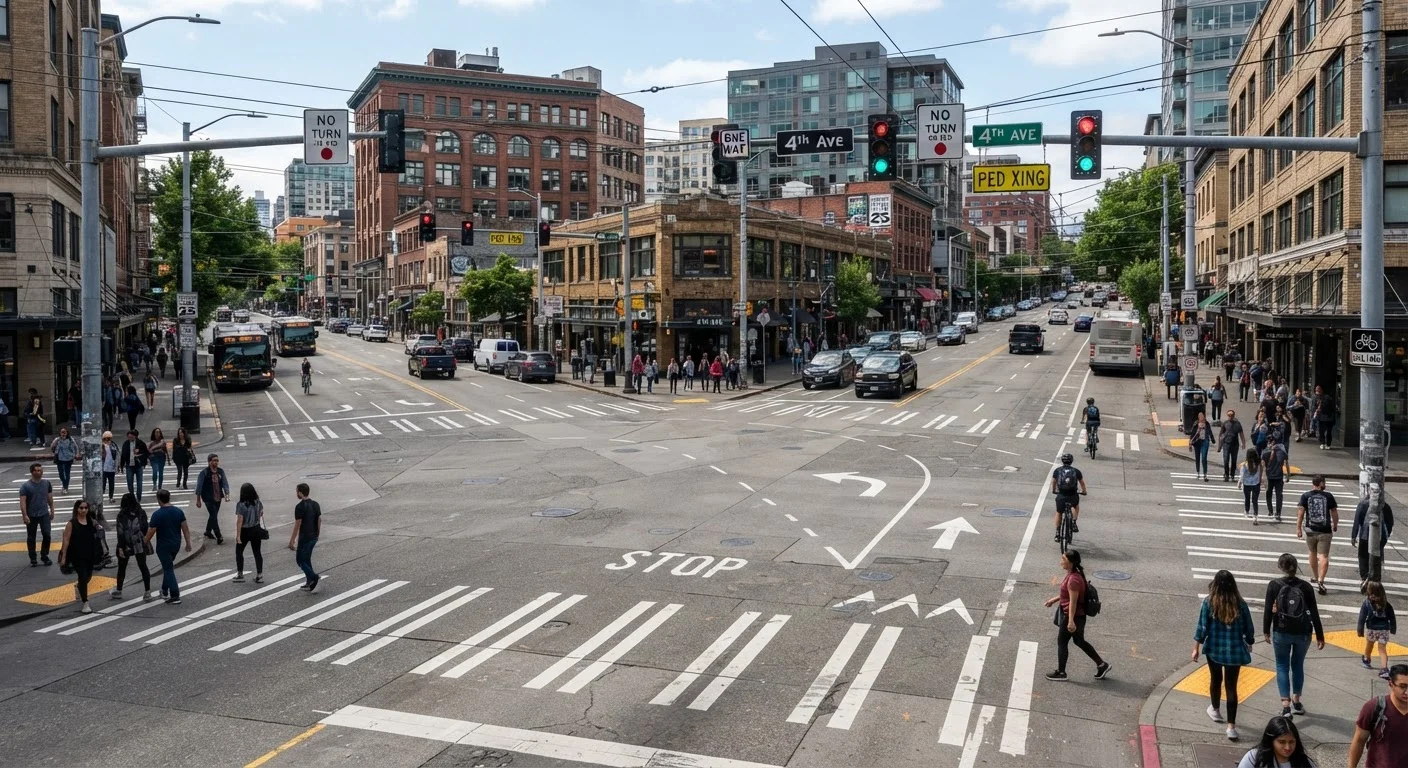
Photo: BridgeWish.com | Reliable Source Of Information editorial
Why Familiar Signs Get Ignored
Drivers process hundreds of signs and markings on every trip, and familiarity breeds selective attention. Research in traffic safety consistently shows that signs encountered repeatedly are processed with less conscious effort over time - a phenomenon sometimes called sign habituation. The result is that some of the most legally significant markings on US roads are routinely overlooked, misread, or misunderstood.
This reference covers the signs and pavement markings that generate the most real-world confusion - what each one means, and what it legally requires of you. For a deeper look at how right-of-way and merging rules interact with these markings, see where drivers go wrong on right-of-way.
| Regulatory sign color | White background with black or red text (Federal Highway Administration (FHWA) Manual on Uniform Traffic Control Devices (MUTCD)) |
| Warning sign color | Yellow background with black symbols (FHWA MUTCD) |
| Pavement marking color - lane separation | Yellow lines separate opposing traffic; white lines separate same-direction traffic (FHWA MUTCD) |
| HOV lane diamond spacing | Typically every 1,000 feet along the lane (FHWA guidance on HOV facilities) |
| Stop line legal requirement | Vehicle must stop with front bumper behind the line (Standard state motor vehicle codes) |
| Flashing yellow arrow adoption | Approved as a national standard by FHWA in 2009 (FHWA MUTCD 2009 revision) |
Signs Drivers Frequently Misread
Flashing Yellow Arrow
A flashing yellow arrow at a signalized intersection means you may turn in that direction - but you must first yield to oncoming traffic and pedestrians. It is not a green light. Many drivers treat it as permission to proceed freely, which can cause serious collisions. The flashing yellow arrow has been gradually replacing the traditional circular green-plus-protected-left combination at many intersections across the US.
White Diamond Pavement Markings
Large white diamonds painted in a lane designate a High-Occupancy Vehicle (HOV) or carpool lane. Driving in this lane without the required number of occupants is a moving violation in most states. The diamonds are often accompanied by a posted sign, but when that sign is missed, drivers may enter the lane legally unaware.
"Do Not Pass" vs. "No Passing Zone" Markings
A solid yellow center line on your side of the road means you may not cross it to pass. A double solid yellow means neither direction may pass. Many drivers treat double yellows as a suggestion, particularly on open rural roads - but crossing them is illegal regardless of visibility conditions. For more on how speed and passing rules interact, see common speed limit myths.
Yield Lines (Triangles and Shark's Teeth)
A row of solid white triangles pointing toward your lane - sometimes called shark's teeth - marks a legally designated yield point. They appear at roundabout entries, pedestrian crossings, and certain merge zones. Drivers who don't recognize these markings often stop unnecessarily or, worse, fail to yield at all. See how roundabouts and complex intersections work for context on where these markings are most common.
Flashing Yellow Arrow
A traffic signal indication allowing a turn in the indicated direction, but only after yielding to oncoming traffic and pedestrians. It does not grant the right of way.
Shark's Teeth
A row of solid white triangles painted on the road surface pointing toward a driver's lane, indicating a mandatory yield point. Common at roundabout entries and certain merge zones.
Fog Line
The solid white line marking the right edge of a travel lane on a highway. It helps drivers orient their lane position in low-visibility conditions and legally defines the lane boundary.
HOV Lane
A High-Occupancy Vehicle lane reserved for vehicles carrying a minimum number of occupants, typically two or three. Marked with white diamonds on the pavement.
Stop Line
A solid white transverse line painted across a lane indicating where a vehicle must come to a complete stop. The front bumper must not cross this line during a stop.
Sign Habituation
A perceptual phenomenon where repeated exposure to familiar signs causes drivers to process them with less conscious attention, increasing the risk of overlooking their legal requirements.
Pavement Markings With Legal Weight
Edge Lines and Fog Lines
The solid white line running along the right edge of a highway lane - the fog line - marks the boundary of the travel lane. Crossing it onto the shoulder without cause is considered improper lane use in many states. In fog or low-visibility conditions, it also serves as a crucial orientation reference.
Stop Lines
A solid white stop line across a lane means your vehicle must stop with its front bumper behind that line - not at the crosswalk, not at the intersection edge. Stopping beyond the line is a traffic violation and can block pedestrian paths. When no stop line is present, the law generally requires stopping before the crosswalk, or before the intersection if there is no marked crosswalk.
Crosswalk Markings
Marked crosswalks do not give pedestrians exclusive right-of-way in every state - rules vary - but drivers are broadly required to yield to pedestrians already in the crosswalk. Unmarked crosswalks at intersections carry the same legal weight in many jurisdictions. Understanding your obligations to pedestrians and cyclists is essential for any driver navigating urban or suburban roads.
Lane Control Arrows
Painted arrows in a lane dictate the only permitted direction of travel from that lane. A lane marked with both a straight arrow and a left-turn arrow allows either movement. A lane marked with only a right-turn arrow means right turns only - proceeding straight is illegal, even if traffic is light. Misreading these arrows at busy intersections is a common cause of last-second lane changes and collisions. For broader context on traffic laws that drivers routinely misread, see traffic laws drivers routinely misunderstand.
~40%
Of US crashes occur at or near intersections
According to the Federal Highway Administration, a significant proportion of traffic crashes involve intersection-related factors including sign and marking compliance.
1 in 3
Drivers unfamiliar with flashing yellow arrow meaning
Surveys conducted during flashing yellow arrow rollouts in multiple states found a substantial share of drivers did not initially understand the signal's yield requirement.
Putting It Into Practice
Knowing what a sign or marking means is the first step - acting on it consistently is the second. Scanning ahead by several seconds rather than reacting at the last moment gives drivers time to process lane-control arrows, yield markings, and upcoming sign changes. This is especially important at complex intersections; see how to navigate intersections safely for a full breakdown of situational awareness at high-risk road points.
If you've been driving for years and haven't reviewed a driver's manual recently, it may be worth revisiting your state's official handbook. Road markings and signage standards do evolve - the flashing yellow arrow is one example - and what you learned at licensing age may not reflect current law. This article is for general informational purposes and does not constitute legal advice; traffic laws vary by state and should be verified with official state sources.
The content on this site is for informational purposes only and is not a substitute for professional advice. Always consult a qualified professional for guidance specific to your situation.