Photo: BridgeWish.com | Reliable Source Of Information editorial
A practical checklist for planning a week's worth of meals that covers major food groups, nutrient diversity, and realistic flexibility for everyday life.
Key Takeaways
Rotating proteins, grains, and vegetables across the week naturally broadens your nutrient intake.
Covering all major food groups does not require complicated recipes or expensive ingredients.
Flexible planning — not rigid meal perfection — makes nutritional variety sustainable long-term.
A written or digital meal map helps you spot gaps before you shop, not after.
Batch-prepping a few staples reduces the daily decision load without sacrificing variety.
Why Nutritional Variety Matters for a Week of Meals
No single food provides every nutrient the human body needs. Spreading a wide range of foods across seven days — rather than defaulting to the same handful of meals — helps ensure you cover vitamins, minerals, fibre, healthy fats, and a full amino acid profile without obsessing over any one dish. This checklist gives you a practical structure for auditing and planning that variety before the week begins.
For a broader look at how these principles apply meal by meal, see our day-in-the-life eating framework. If you want to build habits that outlast a single week, our weekly meal pattern guide walks through sustainable approaches to structuring meals over time.
Mapping the Week's Structure
Write out all 21 meal slots (7 breakfasts, 7 lunches, 7 dinners) on a planner, app, or sheet of paper so gaps are visible at a glance.Must
Decide which meals will be freshly cooked versus planned leftovers, and mark them clearly to avoid accidentally doubling up on the same flavour profile two nights running.Must
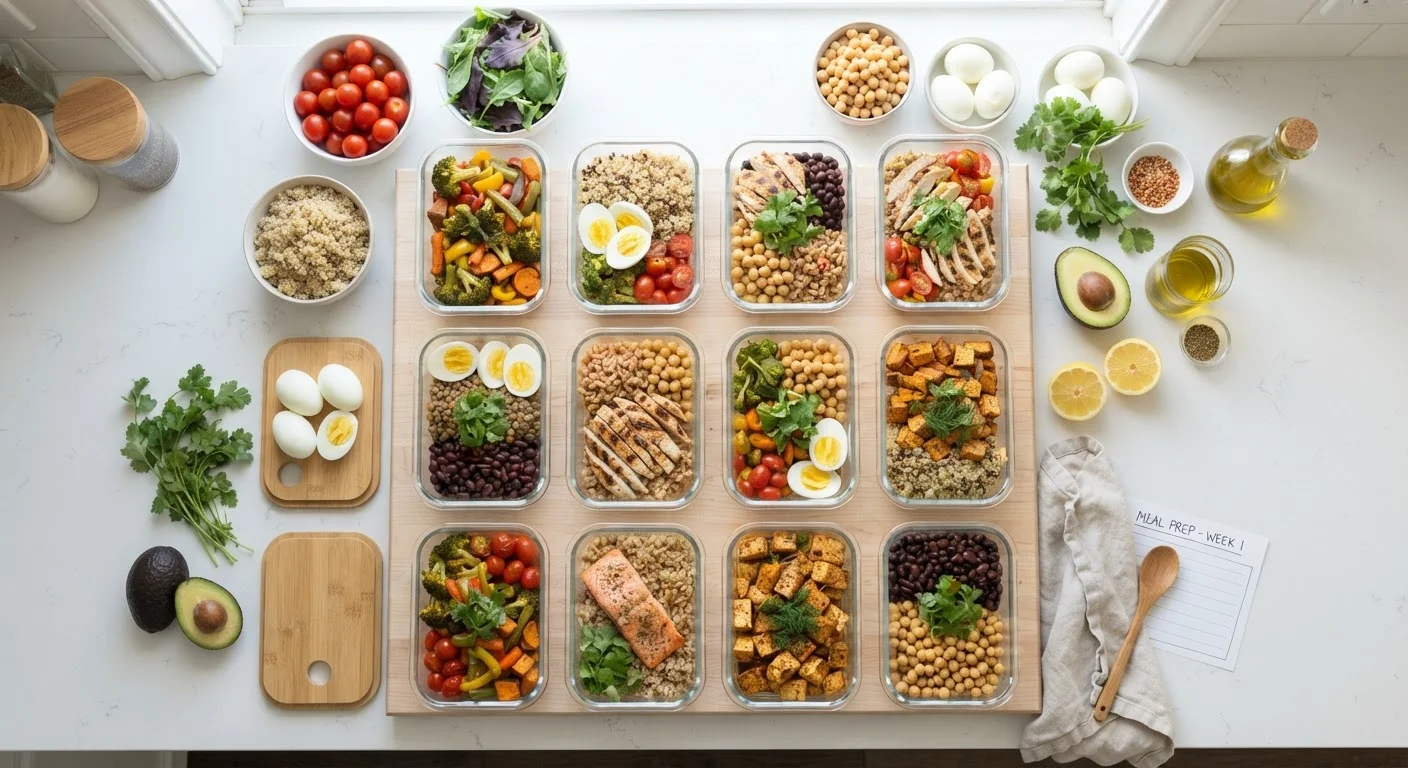
Identify two or three realistic batch-cook anchor meals — dishes whose components (grains, roasted veg, cooked beans) can carry across multiple slots.Should
Reserve one or two planned flexible nights where takeout or a simple pantry meal is acceptable, so the plan accounts for real life from the start.Nice to have
Covering Major Food Groups
Confirm that vegetables appear in at least five dinners and are present across most lunches, aiming for a mix of colours across the week rather than the same two choices.Must
Rotate protein sources — include at least two plant-based options (legumes, tofu, tempeh, edamame) alongside any animal proteins planned for the week.Must
Include whole grains (brown rice, oats, quinoa, barley, whole-wheat pasta) in the majority of grain-based slots rather than relying solely on refined grains.Must
Plan for fruit to appear at breakfast or as a snack on most days, rotating between fresh, frozen, and dried options for practicality.Should
Incorporate dairy or fortified dairy alternatives (such as soy milk) to cover calcium and, where relevant, vitamin D across the week.Should
Building Nutrient Diversity Into the Details
Include at least one serving of leafy dark greens (spinach, kale, collards, Swiss chard) somewhere in the weekly plan to support iron and folate intake.Must
Plan a weekly source of omega-3 fatty acids — such as fatty fish, walnuts, flaxseed, or chia seeds — depending on dietary preference.Should
Swap cooking fats intentionally across the week (olive oil, avocado, nuts) rather than defaulting to one fat source for every meal.Should
Add a fermented food (yogurt, kefir, kimchi, sauerkraut, miso) to at least two or three meals or snacks to support gut microbiome diversity.Nice to have
Check that the week includes a variety of bean or legume types (lentils, chickpeas, black beans, kidney beans) rather than the same variety every time.Nice to have
Snacks and Hydration
Plan structured snack options for each day — ideally combining a protein or healthy fat with fibre (e.g., apple and nut butter, hummus and raw veg, a small handful of mixed nuts).Should
Confirm that water is the primary beverage across the week, with other drinks accounted for in the overall plan.Must
Limit ultra-processed snack foods to no more than one or two planned occasions, so the habit is intentional rather than habitual.Should
Final Plan Review
Scan the full week's plan and flag any day where fewer than three food groups appear at a main meal — adjust before you shop.Must
Check that no single protein source dominates more than three dinners in a row, which can limit amino acid and micronutrient diversity.Should
Confirm that seasonal or budget-friendly ingredient swaps are built in so the plan is realistic for your household this specific week.Should
Write a brief shopping list directly from the finalised plan so nothing is left to memory.Must
Tools That Make Weekly Planning Easier
You don't need elaborate software to plan well, but a few simple tools help you move from intention to a written plan you'll actually follow. Gather what works for your household before starting the checklist.
Required
Weekly meal planner template
Provides a visual grid of all 21 meal slots so you can spot nutritional gaps before you shop.
Required
Grocery list app or notepad
Converts your finalised meal plan directly into an organised shopping list to prevent forgotten ingredients.
Optional
Measuring cups and a kitchen scale
Helps with batch-cooking portions so anchor ingredients stretch accurately across multiple planned meals.
Optional
Airtight storage containers
Keeps batch-cooked components (grains, roasted vegetables, cooked legumes) fresh and ready to assemble during the week.
The guidance in this checklist reflects general healthy-eating principles aligned with widely accepted dietary frameworks, but individual nutrient needs differ based on age, health status, activity level, and other factors. If you have a chronic health condition, follow a medically supervised diet, or are pregnant, breastfeeding, or caring for young children, please work with a registered dietitian or your healthcare provider to adapt any meal-planning approach to your specific needs.
Avoid Eliminating Entire Food Groups Without Guidance
Cutting out a whole food group — even with good intentions — can create nutritional gaps that are difficult to fill without careful planning. If you follow a restrictive eating pattern (vegan, elimination diet, very low carbohydrate, etc.), pay extra attention to nutrients that are harder to obtain from a narrowed food base, and consider consulting a registered dietitian. This checklist is a starting point, not a clinical protocol.
This article is for general informational and educational purposes only and is not a substitute for advice from a registered dietitian or other qualified healthcare professional. If you have specific health conditions, dietary restrictions, or concerns about your nutrition, please consult a qualified professional.
Food Editorial Team is the collective byline for our editorial team and contributor network. Articles published under this byline or an editorial pen name are researched, written, and reviewed according to our editorial standards for clarity, consistency, and independence before publication.
The content on this site is for informational purposes only and is not a substitute for professional advice. Always consult a qualified professional for guidance specific to your situation.