
Sautéing, Pan-Frying, and Stir-Frying: What Sets Each Technique Apart

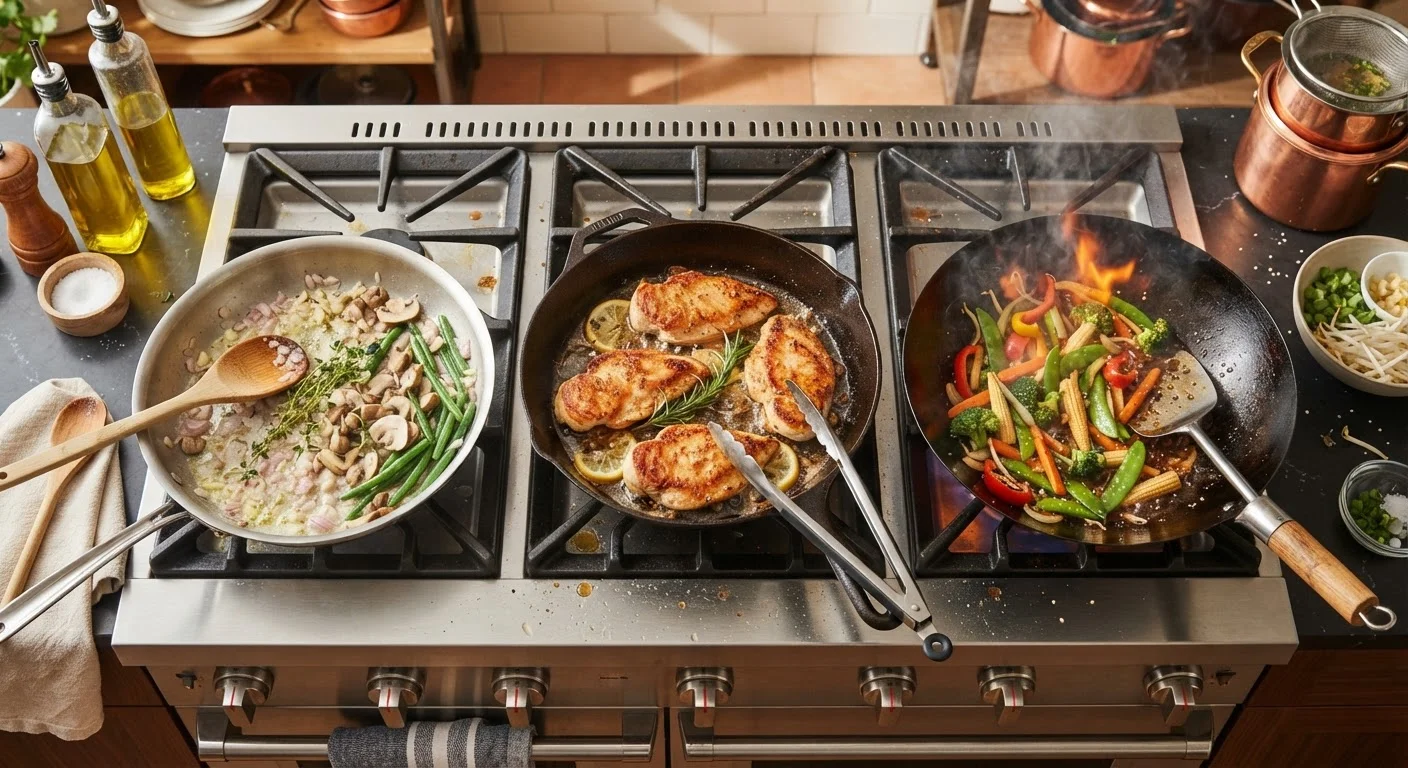
Photo: BridgeWish.com | Reliable Source Of Information editorial
Key Takeaways
- Sautéing uses medium-high heat and minimal fat to cook small, tender pieces quickly with light browning.
- Pan-frying uses more fat and moderate heat to build a substantial, even crust on larger cuts.
- Stir-frying demands the highest heat and fastest movement, preserving color and crunch in small, uniform pieces.
- Choosing the wrong technique for an ingredient leads to poor texture, uneven cooking, or lost flavor.
- Pan choice, oil smoke point, and ingredient prep all directly affect which technique succeeds.
Why These Three Techniques Get Confused
All three methods cook food in a hot pan with fat over direct heat. That shared foundation makes them easy to conflate — but the differences in execution produce dramatically different results. A chicken breast cooked by each method will look, taste, and feel distinct on the plate.
The key variables are: how much fat you use, how high the heat runs, how often you move the food, and how large the pieces are. Get those four factors right, and each technique becomes a reliable, repeatable skill. Mix them up, and food turns out soggy, burnt, or undercooked. See how cooking methods transform the same ingredient to understand why technique selection matters so much.
Sautéing: Light Fat, Medium-High Heat, Frequent Motion
The word sauté comes from the French verb meaning "to jump" — and that captures the method perfectly. You use a small amount of fat (one to two tablespoons), a preheated pan over medium-high heat, and you keep the food moving regularly. The goal is quick, even cooking with light golden color but no thick crust.
Sautéing suits small, tender, or pre-cut pieces: diced onions, sliced mushrooms, cubed chicken breast, shrimp, or thin zucchini rounds. Because pieces are small and heat is high, cooking happens fast — typically two to six minutes. The light fat coating encourages browning via the Maillard reaction without creating a fried texture.
A wide, shallow skillet with sloped sides works best; it lets steam escape so food browns rather than steams. Cast iron and stainless steel both perform well here, each retaining heat differently. Avoid crowding the pan — overlapping pieces trap steam and prevent browning.
Dry Your Ingredients Before Sautéing
Pan-Frying: More Fat, Moderate Heat, Minimal Movement
Pan-frying uses significantly more fat than sautéing — enough to come partway up the sides of the food, though not deep enough to fully submerge it. Heat runs at moderate rather than high, and the food is left largely undisturbed for extended contact with the pan surface. The result is a thick, even, golden crust.
This technique suits larger, denser pieces that need more time to cook through: bone-in chicken thighs, pork chops, fish fillets, or breaded cutlets. The deeper fat layer transfers heat more evenly around the food and helps the crust develop uniformly. A thicker pan — cast iron is particularly suited here — holds temperature steadily when cold food is added.
The trade-off is time: pan-frying is slower and less hands-on than sautéing. You flip once (or twice), not constantly. Flipping too early pulls the food off the surface before the crust has set; patience is part of the technique. Oil selection matters — choose one with a smoke point suited to the temperature you need. A clear breakdown of oil smoke points and best uses helps you avoid burning the fat before the food is done.
Don't Rush the Crust When Pan-Frying
Stir-Frying: Maximum Heat, Constant Motion, Uniform Small Cuts
Stir-frying is the most demanding technique of the three — not in skill, but in pace. It requires the highest heat possible, a small amount of oil, and near-constant movement of uniformly cut ingredients. The goal is rapid cooking that seals in moisture, preserves color, and delivers crisp-tender texture.
Ingredient prep is non-negotiable: every piece must be cut to a similar size so everything cooks at the same rate. Proteins and dense vegetables go in first; leafy greens and aromatics last. A wok's sloped sides allow you to push cooked items up and away from the hottest center zone, giving you control over doneness.
The biggest mistake home cooks make with stir-frying is using insufficient heat. Most home burners can't fully replicate a restaurant wok burner, but you can compensate by cooking in smaller batches and allowing the pan to fully reheat between additions. Crowding drops the pan temperature and turns stir-fry into a braise. For deeper context on how heat mode shapes food, see dry heat vs. moist heat cooking.
| Sautéing | Pan-Frying | Stir-Frying | |
|---|---|---|---|
| Heat level | Medium-high | Moderate | Very high |
| Fat quantity | Minimal (1–2 tbsp) | Moderate (shallow layer) | Minimal (thin coat) |
| Food movement | Frequent | Minimal (flip once) | Constant |
| Ideal ingredient size | Small, diced or sliced | Large whole cuts | Small, uniformly cut |
| Typical cook time | 2–6 minutes | 8–20 minutes | 2–5 minutes |
| Exterior result | Light golden color | Thick, even crust | Crisp, vibrant, lightly charred |
| Best pan | Wide skillet, sloped sides | Heavy-bottomed skillet | Wok or large skillet |
Choosing the Right Technique for What You're Cooking
The simplest decision guide: think about the size of your ingredient and the result you want on the exterior. Small pieces, light browning, fast dinner → sauté. Larger cuts, thick crust, richer texture → pan-fry. Uniform tiny pieces, crunch preserved, speed critical → stir-fry.
Also consider your pan. A stainless steel skillet is forgiving across all three methods; cast iron excels at pan-frying and sautéing but takes longer to heat up for stir-frying. How to choose between cast iron and stainless steel for your cooking style can steer this decision further.
Finally, remember that these techniques exist on a continuum — a sauté can drift toward a pan-fry if you reduce movement and add more fat. Understanding the principles gives you flexibility to adapt on the fly.
The content on this site is for informational purposes only and is not a substitute for professional advice. Always consult a qualified professional for guidance specific to your situation.